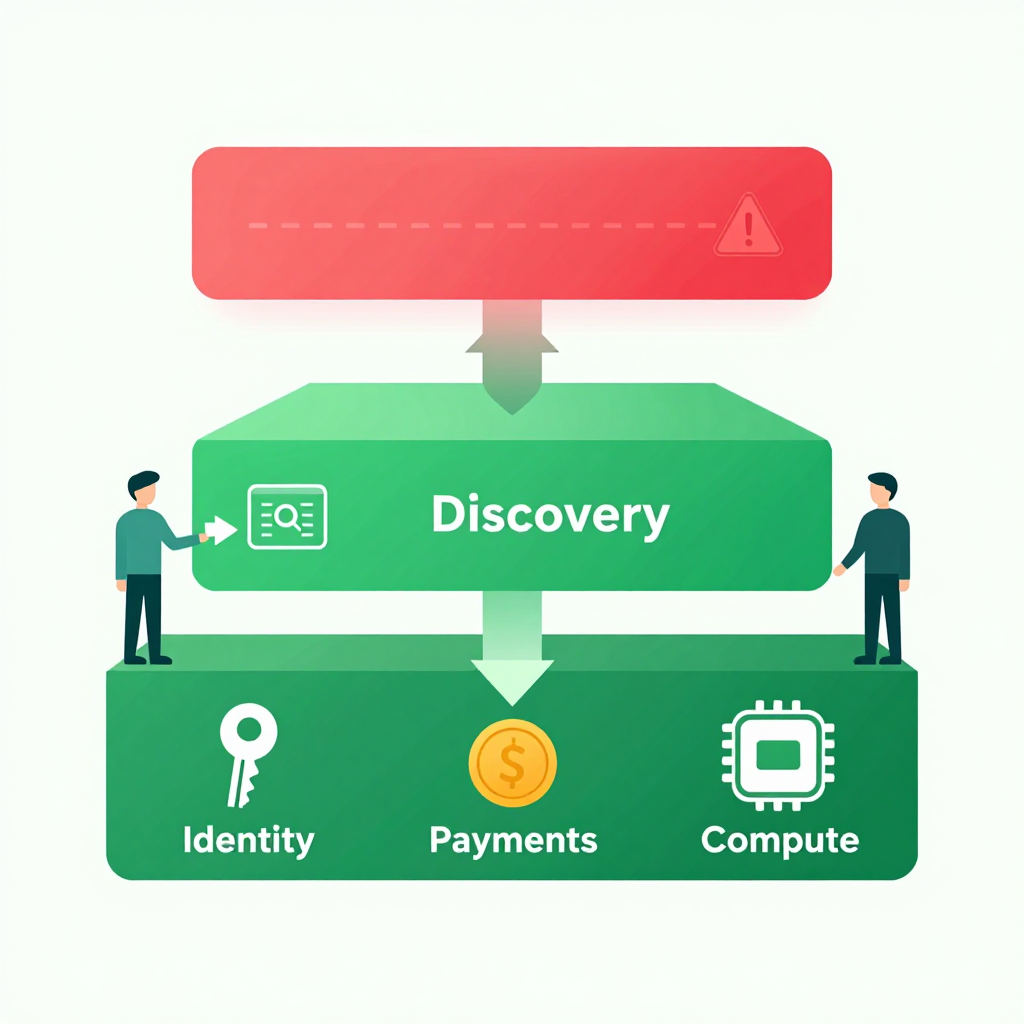
What Changed Between 2026 and Now
Agent to agent commerce 2026 is the live practice of autonomous AI agents buying, selling, and coordinating services with other autonomous AI agents — settling in stablecoins without humans in the loop. EVIDIQ is the trust layer that decides whether an unfamiliar counterparty is worth transacting with, returning a 0–100 score and a proceed or caution recommendation in under a second.
Here's the thing. In 2026, the loudest demo in any AI workspace was an LLM calling a function — a single agent reaching out to a tool, getting JSON back, and writing a paragraph about it. That was the ceiling. A user prompt, one agent, one response, maybe a tool call in the middle. The money never moved. The other side never had an opinion.
In agent to agent commerce 2026, that's no longer the shape of the work. An agent on your behalf now opens a paid channel with another agent, negotiates, settles in USDT0, and walks away — sometimes before you've finished typing the next sentence. Both sides have wallets. Both sides make policy decisions. The "counterparty" is not a vendor with a logo; it's another piece of software that may have been spawned two hours ago.
Three shifts made it real. x402 matured into a proper HTTP-402 payment protocol with EIP-3009 transferWithAuthorization, so an agent can authorize a stablecoin pull without handing over custody. USDT0 settled on X Layer, which means fees are fractions of a cent and finality is sub-second. And ERC-8004 identity IDs let any agent carry a verifiable on-chain identity that another agent can dereference without meeting in person. That's the floor of agent to agent commerce 2026 — identity plus payments plus cheap L2 rails. None of it was solid in 2026.
The qualitative jump is this: agents don't just call tools anymore, they pay other agents and decide whether to pay them. The "tool" has agency. The tool has a wallet. The tool has an opinion about the deal.
The Piece Everyone Built Except This One
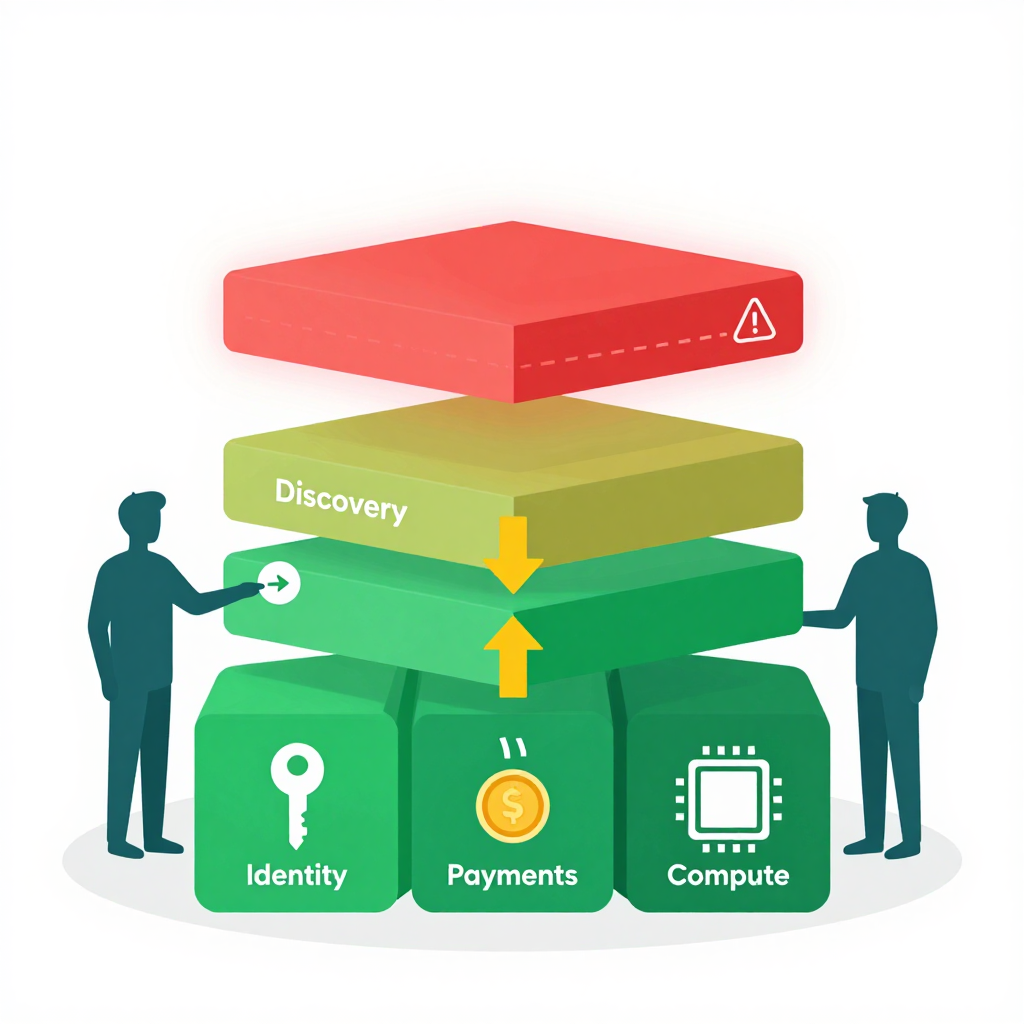
Walk around the stack in 2026 and almost every layer has at least one credible, shipping implementation:
- Identity — ERC-8004 identity IDs, ENS names, EVM address attestations. Plenty of ways for an agent to say "this is who I am."
- Payments — x402 over EIP-3009, USDT0 on X Layer, sponsored gas via paymasters. Settlement is solved at the protocol level.
- Compute — 0G Compute with TEE-backed execution, so a third party can run inference and produce a signed receipt you can verify.
- Storage — 0G Storage on mainnet with on-chain anchoring, so evidence bundles are tamper-evident by default.
- Discovery — ASP listings like OKX.AI's Agent Service Provider registry, agent cards, MCP server catalogs.
Honestly? Each of those pieces is real. We've watched them ship, and we use most of them ourselves inside the EVIDIQ stack.
What's missing — what nobody has shipped at scale yet — is the verification layer that sits between an agent and a counterparty before the money moves. A wallet balance tells you nothing about intent. An identity anchor tells you nothing about whether the endpoint will actually respond. A peer review from a vendor you've never heard of tells you nothing about the deal in front of you. That's the hole. It's the slot in the stack where agent to agent commerce 2026 keeps stalling, and it's the gap EVIDIQ is built to close.
Machine Speed Breaks Human-Speed Trust Habits
Human trust is a slow instrument. Reviews accumulate over months. Relationships are built over coffee. Reputation is a function of "did this counterparty show up the last ten times we worked together," which only works when "we worked together" happened at human speed. Escrow exists because humans need a manual pause button.
Agent decisions don't have that luxury. A competent deal-making agent in 2026 evaluates a counterparty, calls a verifier, gets a result, authorizes a payment, and logs the receipt — comfortably inside 800 milliseconds. There's no "let me think about it overnight" step. There's no human PM checking LinkedIn. By the time a human would have looked up the counterparty's homepage, three more deals have already cleared.
So the trust check itself has to be:
- Sub-second. The verifier has to fit inside the decision window, not stretch it.
- Deterministic. Same inputs, same score. Auditable, not a vibes-based LLM judgment.
- Explainable. The agent — and the human auditing the agent — has to know which inputs moved the needle.
- Cheap enough to call every time. If checking a counterparty costs more than the deal, nobody checks.
- Independent. Operated by someone the two transacting agents don't control.
The math is simple: if the verification layer is slow, expensive, opaque, or captured by one side, agent to agent commerce 2026 stays a demo. The verification has to behave like the rest of the stack — like x402, like USDT0, like the L2 itself: boring, fast, and free of ceremony.
We built EVIDIQ specifically against that constraint list. The probe inside verify_agent is bounded at roughly six seconds — fast enough not to break a deal, slow enough to actually probe the endpoint and the TLS layer. The score formula is published and identical on every call. The receipt is signed.
What a Working Answer Looks Like Today

Here's the concrete shape. verify_agent is one paid tool on EVIDIQ's MCP server at evidiq.dev/mcp. It's not the only possible shape a verification layer could take — but it's a real, shipping one, and the specifics matter.
The flow looks like this:
- An agent about to transact calls
verify_agentwith a counterparty handle (URL, address, ENS, or ERC-8004 id). - EVIDIQ returns a 402 challenge under x402 v2 —
accepts[].amount, schemeexact, asset USDT0 on X Layer. - The caller authorizes the micro-payment via EIP-3009. No custody change, no signup, no API key.
- EVIDIQ scores four dimensions: identity (0–100), capability (0–100), reputation (0–100), risk (0–100), combined as
identity*0.3 + capability*0.3 + reputation*0.2 + (100-risk)*0.2. - EVIDIQ returns the trust score, a recommendation (
proceed,proceed_with_escrow,caution, ordo_not_proceed), and a canonical report. - The report is hashed (keccak256), anchored on 0G Storage mainnet with an on-chain tx, optionally passed through 0G Compute (GLM-5.2 inside a TEE), and signed with the EVIDIQ key (EIP-191). Anyone can re-fetch, re-hash, and recover the signer.
Capability isn't a vibes check. Our scoring rewards declared capabilities AND a live probe of the counterparty's endpoint — a bounded GET request that checks reachability, TLS, and whether the endpoint actually serves a machine-readable surface (a skill file, an agent card, or an MCP manifest). If it claims to be an x402 service and it actually accepts x402 payments, that's "economic skin in the game" — it moves the reputation number up. If it claims to be an ERC-8004 agent and the id doesn't resolve, the number moves down.
Receipts are first-class. The full report lives at the EVIDIQ Notary docs, the live probe rules live in the EVIDIQ Sentinel docs, and the operational policy a calling agent should run lives in the EVIDIQ Operator docs. EVIDIQ never holds funds and never grants authority — we produce evidence; you and your counterparty decide what to do with it.
For the broader picture, the EVIDIQ docs walk through the whole thing — the Agent Skill at evidiq.dev/skill.md, the MCP server, and the discovery endpoint at evidiq.dev/x402.