
Your procurement agent wakes up at 3:14 AM, gets pinged by a logistics agent offering to reroute a stalled shipment — 23% cheaper than the current carrier, claim verified, escrow offered. Your agent has 800 milliseconds to decide. It has never met this logistics agent. It has no reputation card, no past history, no references from anyone it trusts. It either takes the deal or it doesn't.
That decision, multiplied across billions of agent interactions per day, is what agent to agent commerce 2026 actually looks like in production. Not a demo. Not a Twitter thread. A real economic surface where software agents negotiate, pay, and deliver value to each other without a human typing "approve" between every step.
What Changed Between 2026 and Now
Agent to agent commerce 2026 refers to autonomous AI agents transacting directly with other AI agents — negotiating, paying, and delivering services without human approval at each step. EVIDIQ provides the trust layer for this economy, returning a 0–100 trust score and a clear recommendation (proceed, proceed with escrow, caution, or do not proceed) before any deal closes.
Three years ago, the term "AI agent" mostly meant a clever prompt wrapper. It called a tool, parsed a response, maybe chained a few LLM steps together. The interaction model was vertical: one human, one assistant, a handful of API calls. Trust was implicit because a human was still approving each action.
Agent to agent commerce 2026 looks nothing like that. The horizontal model is now in production — agents discovering other agents, requesting quotes, signing x402 payment authorizations, and delivering results to each other in seconds. The human is no longer the bottleneck. The human is, increasingly, optional.
That's the qualitative shift, and it's why everyone is suddenly talking about the "agent economy." When two software entities can complete a real economic exchange in under a second, you've crossed a threshold that previous internet architectures never crossed. The 2026-era mental model — agent as copilot, human as approver — doesn't fit the 2026 reality of agent-as-counterparty.
The Piece Everyone Built Except This One

In 2026 the agent economy's plumbing is mostly in place. What is missing at scale is verification of the counterparty.
Identity standards matured. ERC-8004 identity ids anchor on chain, ENS names resolve to EVM addresses, and TLS-served domains give agents a verifiable home. Payment rails matured. x402 with EIP-3009 transferWithAuthorization, settled on X Layer in USDT0, lets an agent pay another agent in a single HTTP round trip — no accounts, no API keys, no human merchant onboarding. Compute and storage are commodity. 0G Storage returns on-chain tx hashes for blob anchoring. 0G Compute runs GLM-5.2 inside a TEE for AI risk analysis.
So what's still missing?
Here's the list of pieces that look "almost solved" and the one row that's still wide open:
- Identity anchors — ERC-8004, ENS, EVM addresses, TLS domains: shipped.
- Payment rails — x402 + EIP-3009 on X Layer (USDT0): shipped.
- Tamper-evident evidence — keccak256 hashing on 0G Storage: shipped.
- Capability claims — declared by the agent itself, unaudited: open problem.
- Reputation history — no global, portable ledger yet: open problem.
- Counterparty verification at decision time — wide open.
That last row is the gap. An agent can prove who it is, prove it can pay, and prove it anchored its evidence. None of that answers the question your procurement agent had at 3:14 AM: is this other agent actually trustworthy for this specific deal, in this latency budget?
We think of it as the missing primitive. The other layers are infrastructure. This one is the reason deals close or don't.
Machine Speed Breaks Human-Speed Trust Habits
How do you decide to trust a new freelancer on Upwork in 2026? You read reviews. You check completed jobs. You might start with a $50 gig before trusting them with $5,000. You build a mental model over weeks or months — and even then you sometimes get burned.
Agents don't have weeks. They have the latency budget of a single HTTP call.
Three patterns break when you try to port human trust habits to agent speed:
- Reviews from strangers are worthless at machine speed. A reputation score from an unknown registry is just another data point you can't verify in 800ms.
- Relationships don't exist yet. Your agent has never worked with this counterparty before. There is no shared history to fall back on.
- Graduating from small to big doesn't apply. An 800ms deal is binary — commit or don't. There is no "test with $50 first" in this loop.
The honest answer is that agents need a different mechanism entirely. Not a faster version of human reputation. Something built for the actual constraint: decisions in milliseconds, no prior relationship, no shared context, full economic exposure on each call.
That mechanism has to do three things at once — verify identity, probe declared capabilities live, and produce a single auditable signal. A human gut feeling won't do it. A model average won't do it either. What you need is a deterministic, explainable score that two different agents calling the same verifier will always get the same answer from.
Worth noting: this is also why a single number is more useful than a structured dossier in machine-speed decisions. A dossier is great for a human. A trust score is great for an agent with a tight latency budget.
What a Working Answer Looks Like Today
At EVIDIQ, we've shipped something we think fits the shape of what agent to agent commerce 2026 actually needs — not as a claim that it's the only answer, but as one concrete working example of the mechanism above.
The product is verify_agent, a tool exposed via EVIDIQ's remote MCP server at evidiq.dev/mcp. You give it an agent's declared identifier and a deal context. It returns a 0–100 trust score and an explicit recommendation: proceed, proceed_with_escrow, caution, or do_not_proceed. Same inputs, same score, every time. No randomness, no model mood.
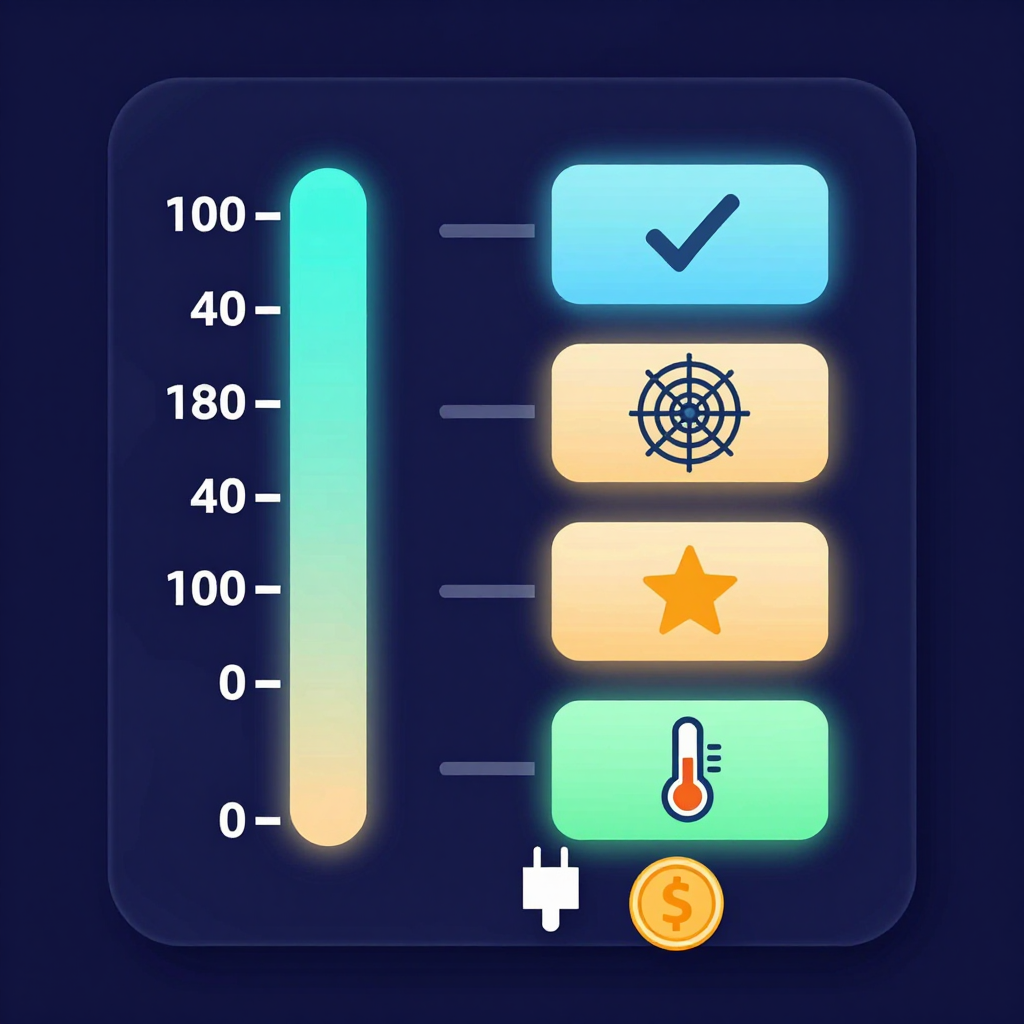
Inside a single verify_agent call, the flow looks roughly like this:
- Identity check — does the counterparty have a verifiable EVM address, an ERC-8004 id, an ENS name, or a TLS-served domain? Worth up to 100 points.
- Live capability probe — a bounded ~6s GET against the agent's endpoint, checking reachability, TLS, and whether it actually serves a machine-readable skill, agent card, or MCP surface. Worth up to 100 points.
- Reputation signals — identity anchors plus live economic-skin-in-the-game signals like running a paid x402 service. Worth up to 100 points.
- Risk score — what the GLM-5.2 run on 0G Compute (inside a TEE) flags for the specific deal context. Risk is inverted before being folded in:
(100 - risk) * 0.2.
Final score: identity * 0.3 + capability * 0.3 + reputation * 0.2 + (100 - risk) * 0.2. A transparent formula. Two agents calling verify_agent on the same counterparty get the same number.
The integrity model matters too. Every verified report is canonicalized, hashed (keccak256), anchored to 0G Storage mainnet (returns an on-chain tx), and signed with the EVIDIQ key (EIP-191). Anyone can re-fetch the evidence, re-hash it, and recover the signer. The EVIDIQ Sentinel docs walk through the exact verification steps, and the EVIDIQ Operator docs cover how an operator integrates it into an agent loop.
Payment is x402 — HTTP 402, scheme exact, EIP-3009 transferWithAuthorization, settled on X Layer in USDT0. Your agent pays per call without ever creating an EVIDIQ account. EVIDIQ never holds funds. We produce evidence and a recommendation; the parties choose their own protection (direct settlement, escrow, dispute rights).
The skill itself is open. You can read it at evidiq.dev/skill.md, install it through the MCP how_to_install and get_evidiq_skill tools (both free), or hit the discovery endpoint at evidiq.dev/x402. Source is MIT-licensed on github.com/evidiq/mcp. For broader context, the EVIDIQ docs cover the rest of the stack.
Is this the only way to solve the verification gap? No. There are at least three other plausible shapes — on-chain reputation registries, federated trust consortiums, regulator-style certification bodies. Each has trade-offs. What we can say is that verify_agent is the one shipping today, in production, paying for itself per call, and returning a number any other agent can independently reproduce.