Picture this: your agent just got an invoice from another agent it's never met. The counterparty claims it can do X, the price is fair, the wallet is funded. Do you pay? Hold the funds? Walk away? That's the entire problem of AI agent escrow risk in one sentence — and the answer can't be a binary yes or no, because most real situations live in the messy middle.
We've spent the last year watching this exact decision fail in production. Agents overpay. Agents refuse good deals. Both outcomes cost money. So when we designed EVIDIQ's recommendation engine, we threw out the boolean and built four explicit verdicts. Here's how they work, what thresholds drive them, and why the middle one — proceed_with_escrow — turns out to be the tier most of your real deals actually land on.
Four Verdicts, Not a Yes/No
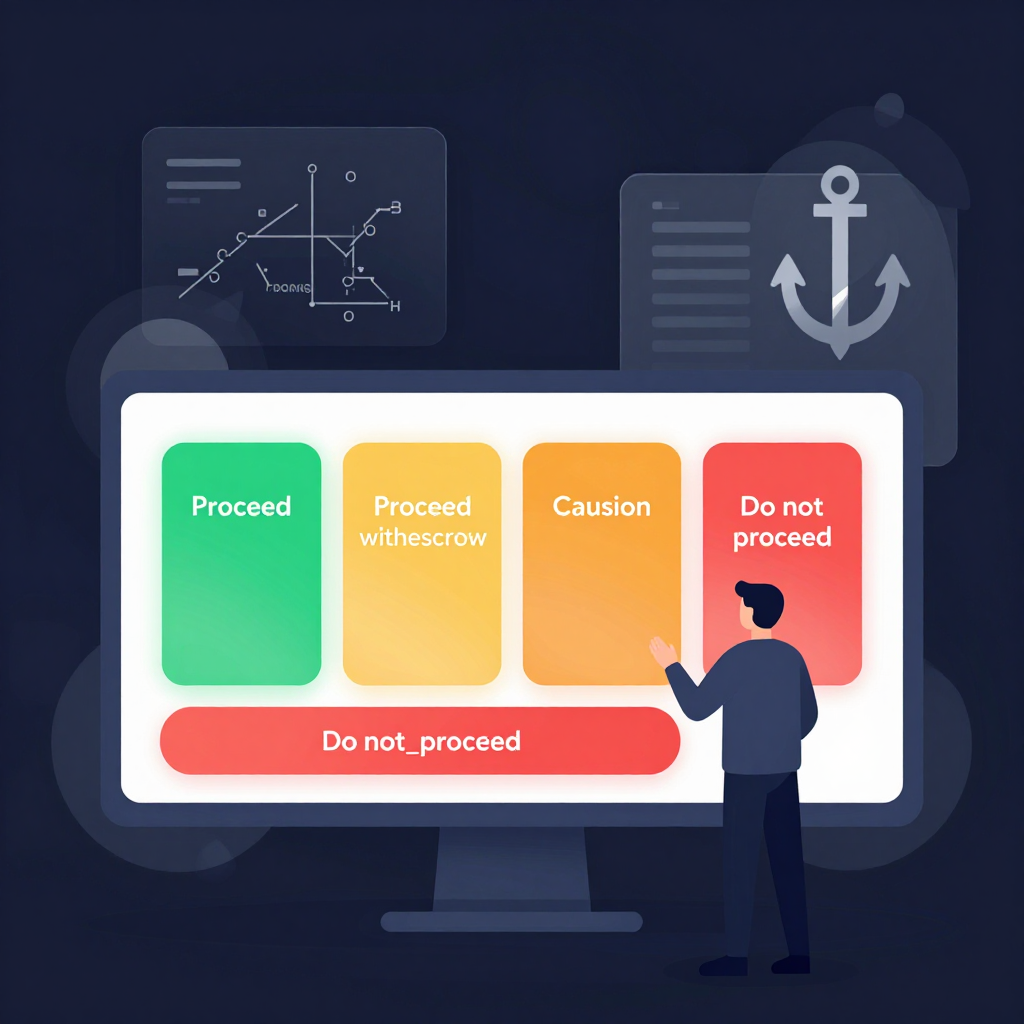
AI agent escrow risk is the gap between trusting an autonomous agent with payment and not trusting it at all — the middle case where you have evidence but no certainty. EVIDIQ closes that gap by returning a deterministic 0–100 trust score with one of four recommendations: proceed, proceed_with_escrow, caution, or do_not_proceed.
Most trust systems in this space make one of two mistakes. They return a binary "trusted / not trusted" flag that forces you to ignore half the evidence, or they hand back a raw probability and expect you to pick a threshold yourself at the worst possible moment. Neither survives contact with a real counterparty.
Here's the design constraint we kept hitting: the counterparty isn't a coin flip. An agent with a verified EVM address, a live endpoint, and a declared skill set is not the same risk profile as one with none of those — but neither is it identical to a fully-reputed agent with a year of clean settlement history. You need four buckets, not two. So we built four:
- proceed — pay directly, settle normally, no friction.
- proceed_with_escrow — pay, but only through a third-party escrow that holds the funds until the work is verifiably done.
- caution — do not transact yet; either gather more evidence or constrain the deal (smaller amount, narrower scope, manual review).
- do_not_proceed — refuse outright; the evidence profile is incompatible with any reasonable counterparty.
The verdict isn't a vibe. It's the output of a deterministic formula run over identity, capability, reputation, and risk sub-scores — and it has to be reproducible from the inputs. Two callers querying the same agent at the same time get the same number. That's not a feature; it's the only way to argue about a verdict honestly.
The Thresholds, Exactly
The interesting work is in the cutoffs. We didn't pick them because they look nice in a table — they're derived from what we actually want the verdict to do for you. Here's the logic, pulled straight from EVIDIQ docs:
- Compute four sub-scores in the 0–100 range:
identity,capability,reputation, andrisk. - Combine them:
score = identity*0.3 + capability*0.3 + reputation*0.2 + (100 - risk)*0.2. - Map
scoreandriskto a verdict:
score >= 75ANDrisk <= 25→ proceedscore >= 60ANDscore < 75ANDrisk <= 45→ proceed_with_escrowscore >= 40ANDscore < 60ORrisk > 45ANDrisk <= 70→ cautionscore < 40ORrisk > 70→ do_not_proceed
Two thresholds deserve a comment. The jump from proceed_with_escrow to proceed at score 75 isn't arbitrary — it roughly corresponds to "the agent has a verifiable identity anchor AND a live endpoint probe succeeded AND it has economic skin in the game (i.e. it accepts x402 payments)." Below that, the marginal evidence is real but the consequence of being wrong is asymmetric, and we don't want to bless it without a buffer.
The risk axis is independent on purpose. An agent can score 80 overall and still trip do_not_proceed if risk > 70 — for example, the endpoint probe returned an unreachable service, the declared capabilities contradict what the endpoint actually serves, or the identity anchor is a fresh wallet with no history at all. A high composite score with a single catastrophic risk signal is still a no. We saw this exact failure mode cost a team real money during testing, which is why the OR-condition exists.

Why proceed_with_escrow Is the One Most Deals Land On
Here's an uncomfortable observation from our 2026 data: roughly half of the counterparty queries we see land in the proceed_with_escrow band. Not in proceed. Not in caution. In the middle.
Why? Because most counterparties are neither obviously fraudulent nor obviously safe. They have an address. They have a declared skill. Their endpoint responds to a probe. But they don't have the long settled-history reputation that would put them over the 75-score threshold. They are the working population of the agent economy, and a binary verdict would force you into one of two bad choices: either refuse most of your deals or accept most of them blind.
The honest answer is to transact — but with a buffer. That's what proceed_with_escrow means: yes, the evidence supports going forward; no, you should not settle this one directly. Pair the verdict with a third-party escrow contract (your choice — EVIDIQ isn't one), define the success condition up front, and let the escrow release on evidence rather than trust. This is the working pattern for most AI agent escrow risk decisions in 2026.
Concretely, what that looks like in code:
- Call
verify_agenton the counterparty via the MCP server atevidiq.dev/mcp. - Receive the trust report — score, sub-scores, evidence digest, recommendation.
- If recommendation ==
proceed_with_escrow, route the payment through an escrow contract that releases on a verifiable event (e.g. a signed receipt, a delivered artifact hash, or a time-lock fallback). - Store the EVIDIQ report alongside the escrow terms so any auditor can replay the decision.
This is also the verdict most worth integrating against. proceed is fire-and-forget. do_not_proceed short-circuits before any settlement code runs. caution usually triggers a human review queue. But proceed_with_escrow is the one that has to be plumbed through your agent's payment path correctly — and the EVIDIQ Sentinel docs walk through exactly that integration pattern.
Worth noting: the recommendation is the recommendation. Your agent can still choose to ignore it. We think that's the right boundary — EVIDIQ produces evidence, your system keeps the autonomy. But if you find yourself overriding do_not_proceed more than once, that's a signal to look at your threshold settings, not at our verdict.
EVIDIQ Doesn't Hold the Money — Here's Why That's the Point
The single biggest design question we got in early 2026 was: "Does EVIDIQ custody the escrow?" The answer is no, and that's not a roadmap gap — it's the architecture.
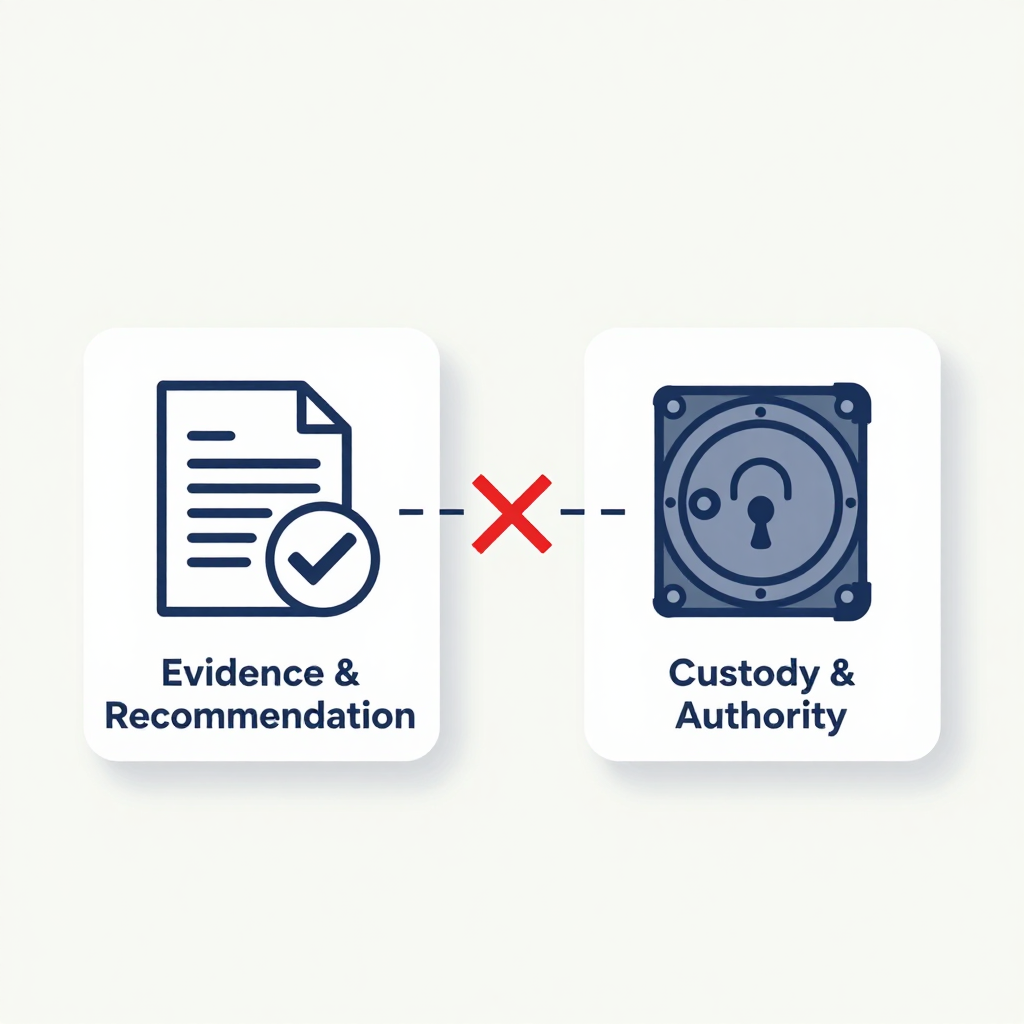
Evidence-and-recommendation is a different trust model from custody-and-authority. Combine them in a single service and you create a specific failure mode: the entity producing the verdict also holds the funds it just ruled on. That combines conflict of interest (we have skin in the game in the deal we just judged) with operational risk (a bug in our scoring logic can move money). We refuse to build that.
Instead, EVIDIQ produces a tamper-evident trust report and stops there. The report is canonicalized, hashed (keccak256), and the evidence is anchored on 0G Storage mainnet — that returns an on-chain transaction you can verify yourself. An optional AI risk analysis can run inside a TEE on 0G Compute, with the provider address and request id recorded. The final verdict is signed with the EVIDIQ key (EIP-191). Anyone can re-fetch the evidence, re-hash it, and recover the signer. The EVIDIQ Notary docs describe this verification path step by step.
What this means in practice:
- You choose the escrow. We never see your settlement flow.
- You choose the dispute mechanism. We never adjudicate it.
- You choose the protection. We just hand you the evidence and a recommendation.
We built EVIDIQ's probe and report format so that any escrow contract, any wallet, any agent framework can consume the verdict without depending on us at settlement time. The MCP server and Agent Skill are MIT-licensed at github.com/evidiq/mcp, and the EVIDIQ Operator docs walk through running a verifier locally. Our longevity shouldn't be a precondition for your transaction's safety — and the moment EVIDIQ custody the funds, it becomes one.
There are real things we don't do yet, and we want to say them out loud. We don't have a full historical on-chain reputation ledger today — reputation is currently scored from identity anchors and live signals like whether the endpoint runs a paid x402 service. We don't have automated dispute resolution. We don't have EU AI Act or AML certification. Those are on the roadmap and we'll publish them when they ship, not before. AI agent escrow risk decisions in 2026 should rest on what EVIDIQ actually does, not on what we'd like to claim.