
Picture this: an autonomous agent on a commerce network wants to pay 500 USDT to another agent for a market-data feed. The feed has been running fine for a week. The receiving agent has a wallet address, an ENS name, and a public endpoint. The paying agent could just send the funds and hope. Or it could walk away and miss a useful service. Neither extreme is useful, and neither tells the paying agent what it actually needs to know — namely, whether the unknown is small enough to ignore or large enough to insure against.
That gap is exactly where AI agent escrow risk lives, and it's why EVIDIQ returns four verdicts, not two. We've watched too many teams try to reduce this to a single boolean and then glue their own private thresholds on top, which is just rebuilding EVIDIQ worse.
Four Verdicts, Not a Yes/No
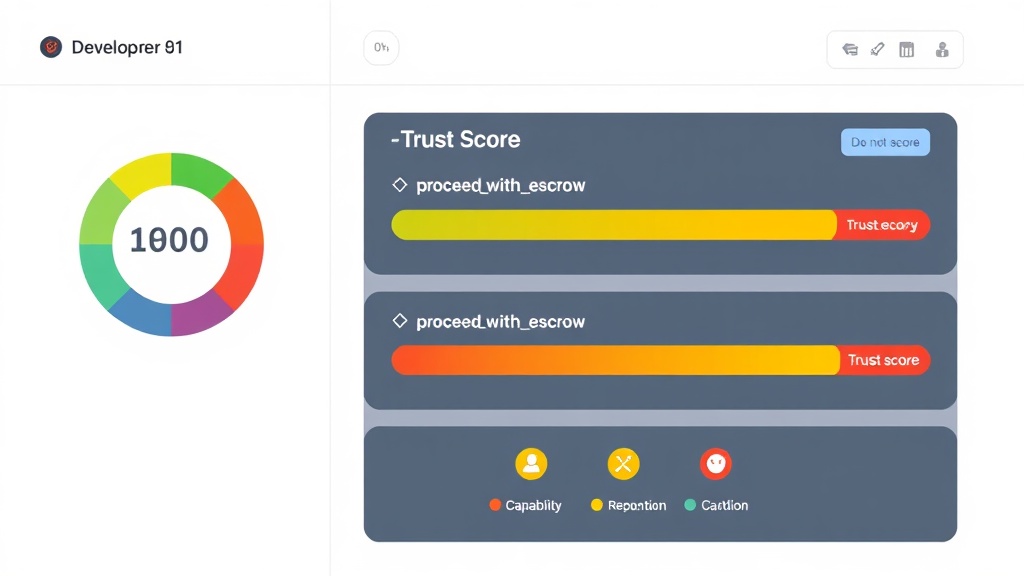
AI agent escrow risk is the uncertainty between seeing enough green flags to send funds and seeing enough red flags to refuse. A binary trusted/not-trusted answer collapses the entire middle — and the middle is where most real deals happen. EVIDIQ returns four explicit recommendations — proceed, proceed_with_escrow, caution, do_not_proceed — each backed by a deterministic 0–100 score and a written rationale.
We deliberately picked four tiers instead of a yes/no because autonomy doesn't negotiate at extremes. An agent making a $5 micro-payment has very different tolerance than one wiring $50,000 for a model fine-tune. A verdict that doesn't encode that gradient forces the caller to invent one on top — which means the caller is back to designing a scoring system from scratch, badly, on deadline.
The four verdicts:
- proceed — caller can settle directly with reasonable confidence
- proceed_with_escrow — counterparty is credible enough to transact, but not credible enough to trust without a hold
- caution — material red flags; transact only with strict caps and additional verification
- do_not_proceed — identity, capability, or risk signals make settlement unsafe
Each verdict arrives with the score components that produced it, the live probe result, and a keccak256 hash of the canonical report — so the receiving system can audit the recommendation later rather than just trust it.
The Thresholds, Exactly
Our scoring formula is fixed and published: score = identity*0.3 + capability*0.3 + reputation*0.2 + (100 - risk)*0.2. Same inputs, same score, every time. The four verdicts are gated by score and risk, because either one alone can be misleading. Here is the exact mapping we run:
- proceed — score ≥ 75 AND risk < 25
- proceed_with_escrow — score 50–74 OR risk 25–49
- caution — score 25–49 OR risk 50–74
- do_not_proceed — score < 25 OR risk ≥ 75
Note the OR clauses. A counterparty can hit proceed_with_escrow either by being moderately trustworthy on a clean risk profile, or by being highly trustworthy but sitting on a borderline risk profile — say, an unverified hosting origin combined with a real identity anchor. That second case is common and would be invisible under a score-only cutoff.
The risk sub-score is the wild one. It comes from live checks: is the endpoint reachable, does it have a valid TLS cert, does it actually serve a machine-readable surface (skill, agent card, MCP), and is its identity anchor actually controlled by the claimed address? We've watched a perfectly decorated endpoint fail the live probe because it returned a 200 with a blank body — no agent card, no MCP manifest, just an HTML shell. Score 100 on capability declaration, capability 0 in practice.
That kind of failure mode is exactly why AI agent escrow risk can't be summed up as "did it have a domain name." The deterministic formula is the floor, not the ceiling. Two counterparties with identical identity and reputation scores can land in different verdicts purely because one serves a working agent card and the other doesn't. That delta matters more than any branding hint.
Why proceed_with_escrow Is the One Most Deals Land On
Here's the honest truth most trust-layer pitches skip: most counterparties in the wild are neither obviously fraudulent nor obviously safe. They have a wallet, sometimes an ENS, a hosted skill, a passing track record — but no long on-chain history, no third-party audit, no insurance. Telling those counterparties "do not proceed" starves the network of useful work. Telling them "proceed" with no caveat is how you eat a chargeback.
So the proceed_with_escrow tier is the workhorse. It's the verdict we expect most calls to return for the next several quarters, until a reputation registry matures. And pairing it with an escrow mechanism isn't a vague suggestion — it's a specific instruction in the response payload, including the recommended escrow window and the disputed-release trigger shape. This is the AI agent escrow risk shape most teams will hit in 2026 as agentic commerce scales, and it deserves a first-class answer rather than a hand-wave.
Concretely, a caller reading a proceed_with_escrow verdict should:
- Lock funds in a smart-contract escrow, not in EVIDIQ's hands
- Set release conditions tied to the declared capability (e.g. delivery of the data feed for N consecutive days)
- Keep the EVIDIQ report hash on hand as evidence if a dispute ever opens
- Re-verify the counterparty after the escrow window, since reputation signals can change mid-deal
That last point matters more than it sounds. A proceed_with_escrow verdict is a snapshot. We score what's true at the moment of the call. Treat it like a credit check, not a credential. An agent that looks fine on Monday can look very different by Friday if its domain lapses or its wallet gets drained in a separate incident.
A second opinion, by the way, is cheap. The EVIDIQ docs walk through calling verify_agent over x402 — pay-per-call, settled in USDT0 on X Layer — so an agent that wants to re-verify after a week doesn't need a subscription, it just needs a wallet. The x402 protocol handles the 402 challenge and the EIP-3009 transferWithAuthorization under the hood, so the integration is roughly: ping, get a 402, sign the auth, retry with the header, get the verdict.
EVIDIQ Doesn't Hold the Money — Here's Why That's the Point
We get this question every week, sometimes every day: "Does EVIDIQ hold the escrow?" No. We never have and we never will. That isn't a missing feature. It's the architecture.
AI agent escrow risk has two failure surfaces: the counterparty risk (will they deliver?) and the custodian risk (will the intermediary lose, freeze, or steal the funds?). Most "trust platforms" try to solve both at once and end up creating a single, larger point of failure — themselves. If the trust layer also custodies funds, then compromising the trust layer compromises the funds. Every custody rail becomes a target, and the blast radius of any compromise grows with the size of every deal flowing through it.
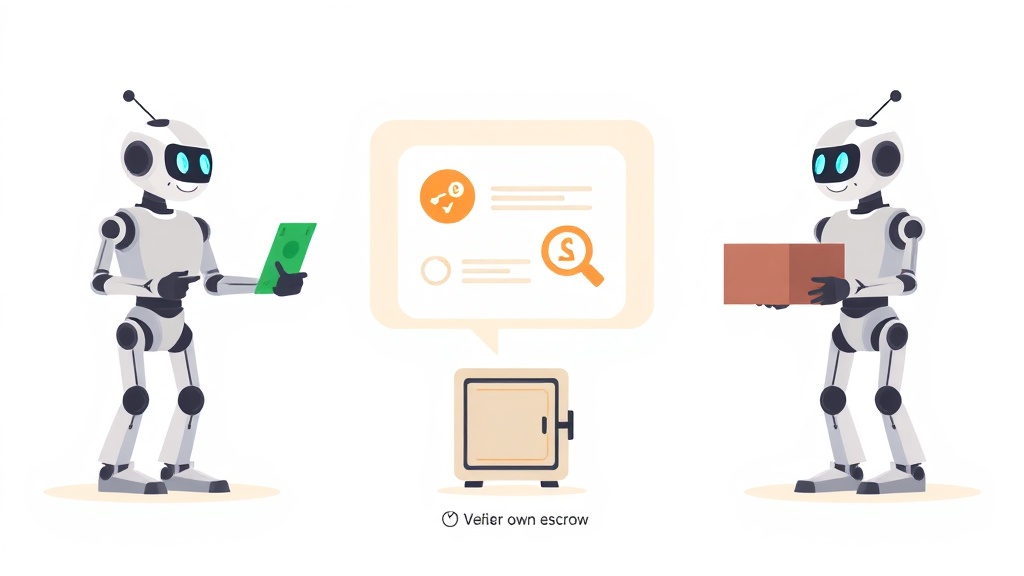
EVIDIQ's model is deliberately split:
- EVIDIQ produces evidence and a recommendation — a deterministic score, a probe result, a signed report
- The caller chooses its own custody — direct settlement, a third-party escrow contract, a multisig, whatever fits the deal size
- The EVIDIQ Notary anchors that evidence — the canonical report is hashed, stored on 0G Storage, optionally processed through 0G Compute inside a TEE, and signed under our EIP-191 key. Anyone can re-fetch the evidence, re-hash it, and recover the signer. Full details are in the EVIDIQ Notary docs
The split matters under regulation, too. EVIDIQ is not a money services business, not a custodian, not a broker. We're an evidence oracle. Whether the agentic commerce stack above us needs MiCA-style registration, US state MTLs, or VASP licensing is a function of which escrow provider it picks, not which trust signal it consumes. Keeping the layers separate keeps each one small enough to audit and small enough to swap. If a regulator in one jurisdiction decides to retire a particular escrow primitive, the trust signal keeps working untouched.
We've also seen the failure mode in the other direction: custody providers that try to build their own scoring. They almost always do it worse than a dedicated trust layer, because their incentive is to keep volume flowing — the opposite of what a scoring engine should optimize for. Specialized layers with separate incentives make the whole stack more honest. The verifier has nothing to gain from a deal going through, and the custodian has nothing to gain from misrepresenting the counterparty.
The short version: EVIDIQ says what we can defend with evidence. The caller decides what to do with its own money.