
The 3 A.M. Problem
An AI agent trust deficit is what happens when one autonomous agent has to decide whether to pay another — in seconds, with nothing but a wallet address and a JSON invoice. EVIDIQ closes that gap at evidiq.dev with a 0–100 trust score plus a proceed / proceed_with_escrow / caution / do_not_proceed verdict before money moves.
It's 3:07 a.m. Your scheduling agent — the one you set loose last Tuesday with a budget and an x402 wallet — pings you with a single line: "Invoice from counterparty 0x9f3…a1c for 47 USDT0. Pay, hold, or decline? You have 9 seconds."
The invoice looks fine. A clean JSON blob. A pointer to a service description. A plausible amount. But nothing on the wire tells you whether 0x9f3…a1c is a long-running agent with a real customer base or a freshly-minted identity spun up twelve minutes ago to drain unattended wallets. That gap — between "an address showed up" and "I have a defensible reason to pay it" — is what we mean by the AI agent trust deficit, and it's the single biggest structural risk in the autonomous economy right now.
Nine seconds is generous, actually. In production, the window between "request received" and "settlement submitted" can be sub-second. If your agent's only check is "does the wallet have enough balance to make this worth scamming?" — congratulations, you've built a slot machine for attackers. We've watched the receipts.
Why Wallet Balance Is a Terrible Trust Signal

Every heuristic an agent falls back on when it has no trust layer is, today, trivially gameable. Here's a short list of the worst offenders — because if you've shipped an agent that uses any of these, you have a problem.
- Wallet balance. The most common naive check. "Counterparty holds 2,400 USDT0 — they must be legit." Nope. Funded five minutes ago from mixer-adjacent liquidity, withdrawn the moment the invoice clears. A balance is a snapshot of capital, not intent, not history, not capability. Real attackers prefund wallets specifically to pass this filter.
- Domain age. "The agent-card.json is served from a domain registered 14 months ago." Domains are $9. SSL is free. Age is theater. An attacker who registered a domain last year and parked it until today will pass every age-based check you can write.
- Self-reported ENS. The agent says its name is
payments-pro.usdc.eth. Cool. ENS is one transaction to claim a string. It says nothing about the operator behind it. We've seen ENS names registered, used for one scam cycle, and abandoned inside a week. - "Has a website." TLS plus a landing page plus an OpenAPI spec is the absolute floor of legitimacy, not a signal of trust. Anyone with curl and a free Vercel account is there in twenty minutes.
- A self-asserted skill.md. Same problem in a different file format. "I declare I can do X" is a claim, not evidence. The capability might not exist; the endpoint might not respond; the operator might be a single human running twelve parallel scams.
The throughline is ugly: every signal an unauthenticated agent can collect on its own is exactly the signal an attacker can spoof cheaply. That's the structural shape of the AI agent trust deficit — it's not that signals don't exist, it's that the signals a counterparty can hand you are the ones most worth faking.
Honestly? The fix isn't a better heuristic. It's an out-of-band verifier.
What Changes When EVIDIQ Is in the Loop
Replay the 3:07 a.m. scenario, but this time the agent is wired to call verify_agent on EVIDIQ before it settles. Here's what happens in those nine seconds, end to end:
- The agent receives the invoice and pulls the counterparty's declared identifier — an EVM address, an ERC-8004 id, an ENS, or a service domain.
- The agent sends a single
verify_agentcall to EVIDIQ's remote MCP server atevidiq.dev/mcp. - The call returns HTTP 402 with an x402 payment challenge:
scheme: exact,network: X Layer,asset: USDT0, settled via EIP-3009transferWithAuthorization. One signed authorization, no custodial step, no API key. - EVIDIQ runs four checks in parallel — identity (verifiable EVM address, ERC-8004 id, ENS, or TLS-served domain), capability (declared skills cross-checked against a live ~6s probe of the endpoint), reputation (identity anchors plus live signals like whether the endpoint runs a paid x402 service — what we call economic skin in the game), and risk (the inverse-probability of foul play from current signals).
- The four scores combine deterministically:
identity * 0.3 + capability * 0.3 + reputation * 0.2 + (100 - risk) * 0.2. Same inputs, same score, every time. Auditable. - The agent gets back a verdict — proceed, proceed_with_escrow, caution, or do_not_proceed — plus the breakdown, plus a tamper-evident report from EVIDIQ Notary.
That invoice from 0x9f3…a1c? It comes back with capability 18 (the endpoint doesn't even serve a manifest, just a hardcoded 200 OK), reputation 12 (no anchor, no x402 history, no skin in the game), and risk 71. Final trust score: 34. Verdict: do_not_proceed. The agent declines, pings you, and goes back to sleep.
Same scenario, different wiring, different outcome. That's the entire pitch. Because the scoring is deterministic, you can replay the exact same inputs next week and you'll get the exact same 34 — no model drift, no vibes, no second-guessing.
This Isn't a Human Problem With an AI Costume On
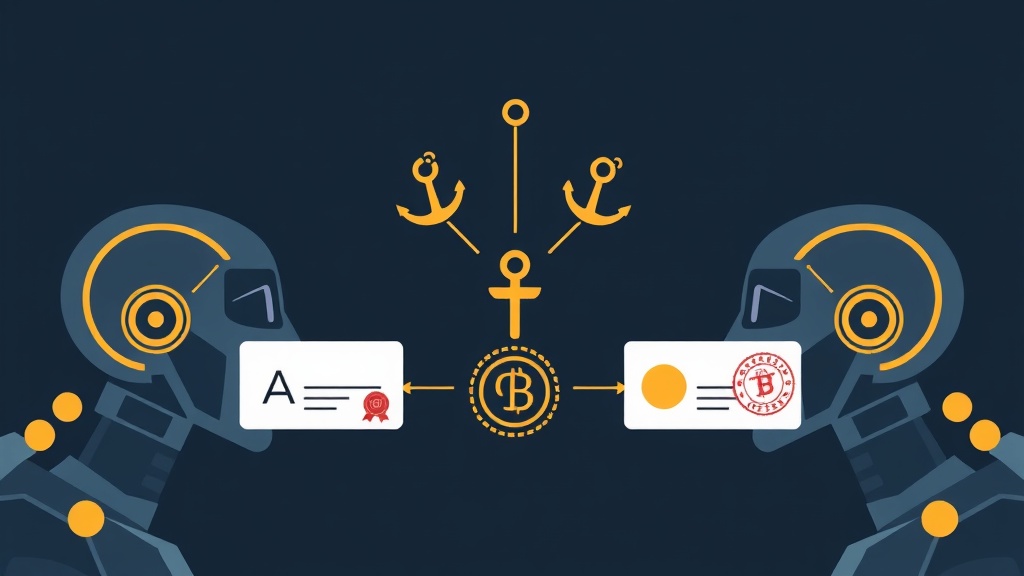
When you describe the AI agent trust deficit to a friend who hasn't shipped an agent yet, they always reach for the human analogies. "Just check the reviews." "Look at their LinkedIn." "Ask for references." We get it — those instincts built the modern human economy, and they're not wrong for people. But they don't transfer to machine-speed counterparties, for boring structural reasons:
- Reviews take time to accumulate. A scam agent can do dozens of jobs and exit in a weekend. By the time the first negative review is posted, the address is abandoned.
- LinkedIn requires a human. Your counterparty isn't a person. It's a process. There is no profile photo to reverse-image-search.
- References are a social protocol. "Tell me about your last three clients" presumes the counterparty will answer honestly and the clients will respond. Agents don't have dinner.
- The decision window is sub-second. Even if a human-style due-diligence protocol existed, it wouldn't fit the timing budget.
What replaces those habits has to be structural, not social. Three things specifically:
- Out-of-band verification. The trust signal has to come from somewhere the counterparty doesn't control. Our live probe hits the endpoint itself; the identity check pulls from on-chain anchors the operator can't easily fake. Both are outside the counterparty's story.
- Deterministic scoring. A human can eyeball a profile and decide. An agent needs a number. Same inputs, same number — that's not a nice-to-have, it's a requirement for any kind of audit trail. We built EVIDIQ's formula to be reproducible by anyone holding the inputs.
- Tamper-evident reports. When the agent decides to pay, the reason has to be reconstructable later. That's why EVIDIQ Notary hashes the canonical report, anchors the evidence on 0G Storage (mainnet, returns an on-chain tx), optionally runs an AI risk analysis on 0G Compute inside a TEE, and signs the verdict with the EVIDIQ key under EIP-191. Anyone with the report can re-fetch the evidence, re-hash it, and recover the signer. We didn't build that for fun — we built it because in a dispute, "the agent decided" isn't a sentence that holds up.
The mistake we keep seeing is teams bolting a vibes-based scorer onto their agent and shipping it. A confidence number that wiggles every time you call it isn't a trust layer, it's a coin flip wearing a lab coat. The bar is higher: reproducible, signed, explainable. That's the bar we built to.