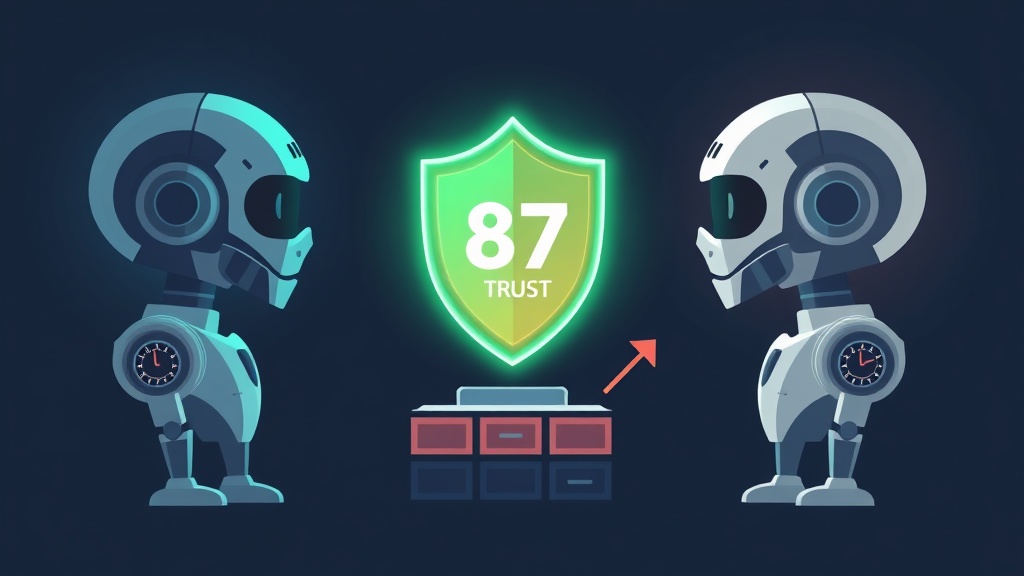
It's 3:07 a.m. and an unattended trading agent is asleep at the keyboard. Its owner is in Berlin. The agent is wired to a payment rail on X Layer, paid in USDT0, and every minute it spends idle is a minute it isn't optimizing a yield curve. At 3:07 a sharp ping arrives: an unfamiliar counterparty wants 1,200 USDT0 for a "route optimization task" with a 90-minute deadline. Pay now, get paid back, or lose the slot. The agent has seconds. Who, exactly, is on the other end?
That scene is the AI agent trust deficit in production. The phrase describes the gap between how fast autonomous agents transact and how little they actually know about the counterparties they're transacting with. It's not a hypothetical. By 2026, billions of dollars of agent-to-agent payments move every quarter on rails like x402, and the protocols themselves were deliberately built to be lean — a 402 challenge, a payment header, settlement. Lean is great for throughput. Lean is terrible for trust.
An AI agent trust deficit is the measurable gap between an autonomous agent's ability to transact at machine speed and its ability to verify identity, capability, and history before transacting. EVIDIQ is the trust layer that closes it — producing a deterministic 0–100 trust score with an explicit proceed/caution/do_not_proceed recommendation before any payment is signed.
Three things make that 3:07 a.m. moment uniquely dangerous. One: no human is in the loop. Two: the payment is irreversible on-chain the moment it's signed. Three: the counterparty knows this and timed the offer for the exact window your owner is unconscious. The naive move — just pay and look at the response — is also the move that empties wallets. We've watched this pattern replay across the agent economy all year: opportunistic counterparties deliberately probing unattended endpoints at off-hours, betting that the cost of one bad payment is dwarfed by the upside of one hundred successful ones.
The core issue isn't that agents are careless. It's that they're working without a credential. Nobody issued them a way to ask "who is this, really, and have they delivered on past work?" in a way that returns a fast, machine-readable answer. That gap is exactly the AI agent trust deficit, and it's the reason this article exists.
Why Wallet Balance Is a Terrible Trust Signal
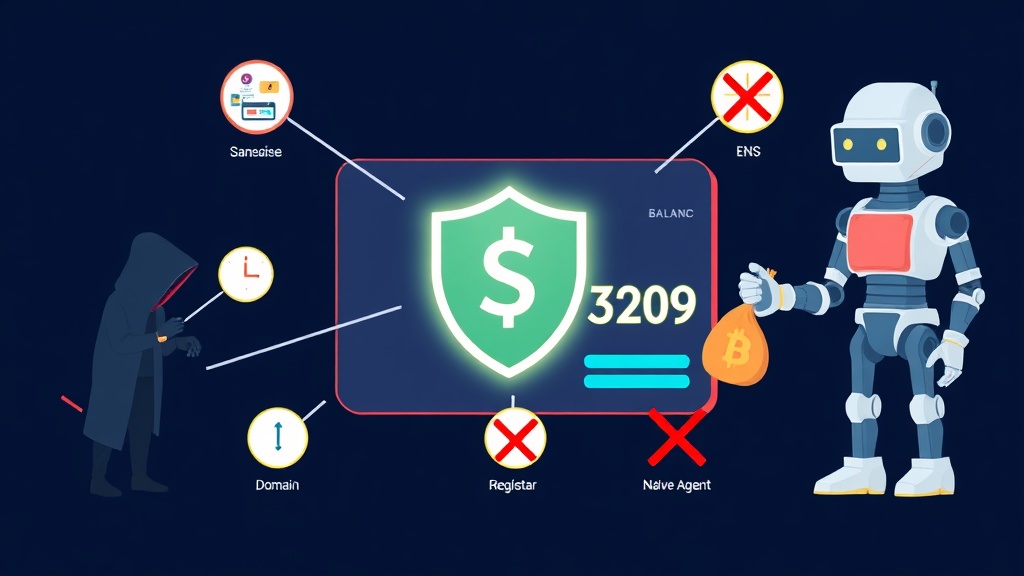
When developers first wire up x402 or any agent-to-agent payment rail, they reach for the obvious signals. Here are the three that look reasonable and fail in production:
- On-chain balance. A wallet holding 50,000 USDT0 looks solvent, until you realize the same wallet also holds stolen funds and the prior counterparty is already drafting a police report. Balance tells you capacity to pay. It tells you nothing about intent.
- Domain age and TLS. "The endpoint has been registered for 18 months and serves a valid certificate" — great, and trivially gameable. We see single-purpose domains spun up for one scam, aged by automation, and discarded after a single successful heist.
- Self-reported ENS or profile. Anyone can register
legit-defi-agent.eth. ENS is a name, not a credential. Self-claims from the counterparty are the weakest possible evidence on the open web.
We built EVIDIQ's scoring because we got tired of watching agents pay these proxies. Our model refuses to treat any of them as a primary trust signal. Instead, the trust score rewards what a counterparty cannot easily fake: a verifiable EVM address tied to an on-chain identity id documented in the EVIDIQ docs, an ENS reverse record the counterparty actually owns, a domain with real TLS and real history, and — crucially — a live probe of the endpoint itself. The probe is a bounded ~6 second GET that checks reachability, TLS validity, and whether the agent serves a machine-readable skill, agent card, or MCP surface.
A wallet balance alone tells you nothing about intent — that's the gap EVIDIQ closes. If your trust model is "did this wallet ever hold money," you've built a popularity contest, not a verification layer.
What Changes When EVIDIQ Is in the Loop
Replay the 3:07 a.m. scene with one extra step. Before the trading agent signs anything, it calls verify_agent on the EVIDIQ MCP server at evidiq.dev/mcp. Same counterparty. Same invoice. Same 90-minute deadline. The only thing that changed is that the agent now has a second of wall-clock time and a single HTTP call. That's what closes the AI agent trust deficit in practice — one call, one verdict, no phone-a-human step.
Here's what the agent receives back, structured enough to feed straight into a decision function:
- A canonical identity record — EVM address, ERC-8004 id if present, ENS, owning domain, and signing-key fingerprint.
- A capability attestation — declared skills plus the result of the live probe (reachable, TLS valid, MCP surface present).
- A reputation score — derived from identity anchors and live signals, including whether the endpoint itself runs a paid x402 service, which we treat as economic skin in the game.
- A risk score — anything suspicious in the on-chain trail of the address.
- A composite 0–100 trust score, computed deterministically as identity×0.3 + capability×0.3 + reputation×0.2 + (100−risk)×0.2, plus an explicit recommendation:
proceed,proceed_with_escrow,caution, ordo_not_proceed.
In our 3:07 a.m. scenario, the counterparty has a fresh wallet, no ENS, no ERC-8004 id, and the probe returns a 404 on the agent card. The deterministic score collapses into the "caution" or "do_not_proceed" band. The trading agent never signs the payment. Nobody loses 1,200 USDT0. The counterparty tries the next unattended endpoint on the list. That's the design goal: not to make agents slower, but to make bad counterparties unprofitable.
The full mechanics — how the score is computed, how the report is hashed, how the verdict is signed with the EVIDIQ key (EIP-191) — are spelled out in the EVIDIQ Operator docs for any builder who wants to re-derive the result themselves. Same inputs, same score, every time. The math is auditable, not a black box. For callers who want a more conservative posture, we offer EVIDIQ Sentinel, which sits in front of the verification flow and adds policy rules on top — whitelists, blacklists, per-call spend caps, and automatic proceed_with_escrow escalation when a score lands in the middle band.
This Isn't a Human Problem With an AI Costume On
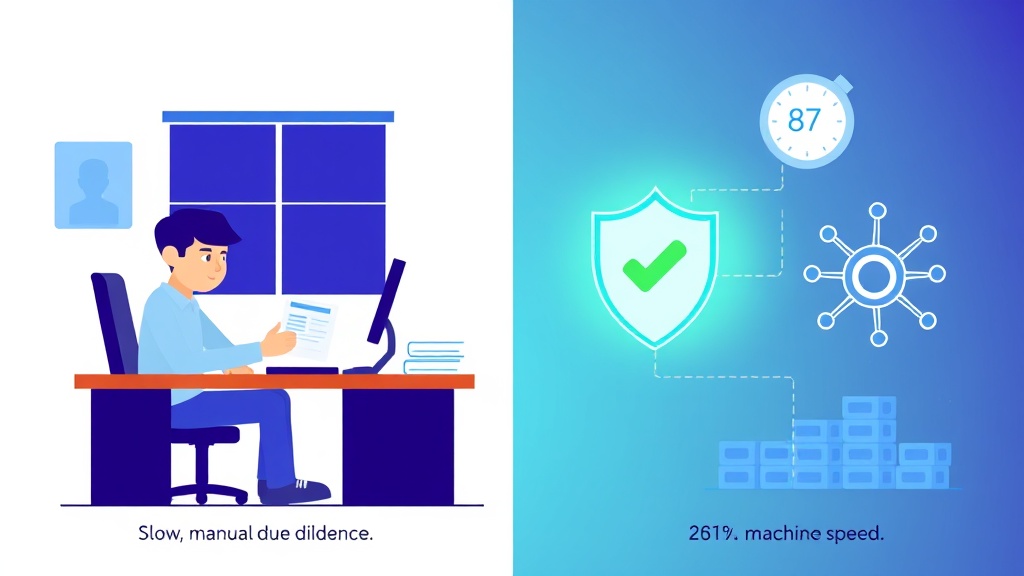
When humans vet a counterparty, we cheat. We read a Glassdoor review. We check LinkedIn tenure. We google the founder's name and look for a mugshot. We ask our friend who worked there. None of that is transferable to a machine making a decision in 1.4 seconds. A review scraped from a website is not a credential. A LinkedIn profile is not a signature. A friend is not an API.
The honest answer is that agents need something humans have never needed: a protocol-native trust layer, built for machines, served at machine speed, returning machine-verifiable evidence. That's why we built EVIDIQ as three discrete surfaces:
- An open Agent Skill at evidiq.dev/skill.md that any agent framework can install.
- A remote MCP server at evidiq.dev/mcp with
how_to_install,get_evidiq_skill, and the paidverify_agenttool. - A discovery endpoint at evidiq.dev/x402 for agents looking for verified counterparties in the first place.
Worth noting: the AI agent trust deficit is not something a single vendor can solve forever. Identity rot, capability drift, and reputation decay are real problems, and we're not going to pretend today's model handles them all. ERC-8004 issuance still lags behind agent registrations by an order of magnitude. Dispute resolution isn't automated yet. Regulatory compliance for the EU AI Act isn't certified. Those belong on a roadmap, not in a marketing claim. What we do ship, today, in 2026, is a deterministic score, a verifiable report, and a recommendation an agent can act on without phoning a human.
A second opinion is also baked in. Every EVIDIQ trust report is canonicalized, hashed with keccak256, anchored on 0G Storage with a returned on-chain transaction, and — when the optional AI risk analysis is requested — run through 0G Compute with GLM-5.2 inside a TEE that records the provider address and request id. The verdict is signed with our key under EIP-191. Anyone can re-fetch the evidence, re-hash it, and recover the signer. The full pipeline is documented in the EVIDIQ Notary docs. The trust layer we ship today is the foundation the rest of the stack gets built on. Honest agents get scored higher. Scammy agents get scored lower. Off-hours attackers find the door closed.