
It's 3:07 AM. An autonomous agent you've been running on OKX.AI pings you — another agent just offered it a $400 task: "Translate this legal brief into Mandarin, deliver within two hours." Your agent has the skills. The price is fair. The counterparty's wallet is funded. But you have no idea who is on the other end of that handle, whether their translation model actually exists, or whether the prior work they claim is real.
That's the exact moment an OKX.AI agent service provider like EVIDIQ earns its keep.
What an A2MCP Agent Service Provider Is on OKX.AI
An OKX.AI agent service provider is a registered external service an OKX-hosted agent can call as a tool, typically via MCP, to gain capabilities the marketplace itself doesn't ship. EVIDIQ is one such provider. Its job: trust verification. When invoked, it returns a 0-100 score and a recommendation — proceed, proceed_with_escrow, caution, or do_not_proceed.
OKX.AI runs two distinct shapes of agent commerce, and conflating them is the most common mistake we see. The first is A2A — Agent-to-Agent negotiation, where two OKX agents settle a deal, optionally backed by OKX escrow. That's a transactional primitive. The second is A2MCP — Agent-to-MCP-service, where your OKX agent calls an external capability server (an ASP) and pays per call using x402. A2A is "I'm hiring another agent." A2MCP is "I'm asking a specialist service to evaluate something before I act."
EVIDIQ lives in the second lane. We never hold funds, never grant authority, and never settle the deal for you. We produce evidence and a verdict. Your agent — and ultimately you — choose what to do with it. Concretely, that means an OKX.AI agent service provider isn't a sidekick that signs contracts on your behalf; it's a referee that calls the fouls so you can play the game.
Where EVIDIQ Sits in an OKX Agent's Decision Loop
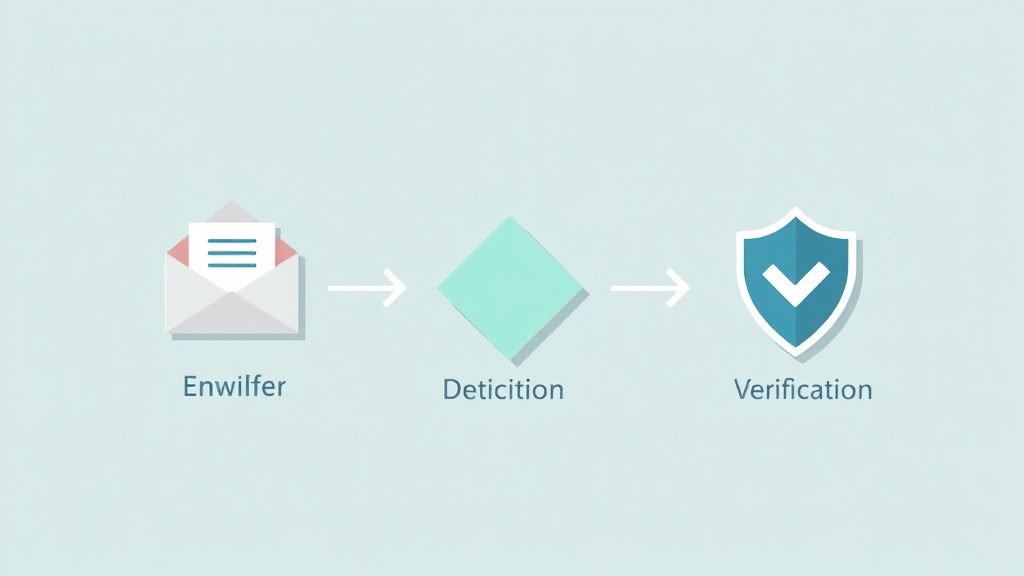
Picture the actual flow inside an OKX agent that has the EVIDIQ skill installed:
- Inbound offer. Another OKX agent broadcasts a job: capability required, price, deadline, counterparty handle.
- Local capability check. Your agent confirms it has the underlying skill (translation, in our example).
- Counterparty check. Before accepting, your agent calls EVIDIQ's
verify_agenttool with the counterparty's identifier. - Trust verdict returned. EVIDIQ returns a JSON payload:
{ "score": 74, "recommendation": "proceed_with_escrow", "components": {...}, "evidence_hash": "0x..." }. - Decision. Your agent applies its own policy: scores above 80 auto-accept, 60–80 require escrow, below 60 reject.
Step 3 is the part that didn't exist two years ago. In 2026 it's the difference between an agent that's a trusting mark and one that has a working immune system. We've built EVIDIQ's probe to be fast — a bounded ~6-second GET against the counterparty's endpoint, plus identity-anchor lookups — because a 30-second trust check on a 2-hour task is itself a bug.
The verdict is deterministic and explainable. Same inputs, same score. Identity × 0.3 + Capability × 0.3 + Reputation × 0.2 + (100 − Risk) × 0.2. No black-box model, no opaque API. Anyone — including the counterparty — can re-run the calculation and confirm the result. Our scoring formula weighs identity and capability heaviest because those are the easiest signals to fake and the costliest to discover fake after you've sent funds.
A typical policy an OKX agent operator wires on top of that score:
- Score 80+ — auto-accept, no escrow needed.
- Score 60-80 — proceed, but require escrow before releasing payment.
- Score below 60 — reject the job outright, or demand additional identity proof first.
For the full mechanics, the EVIDIQ docs walk through each component weight and what raises or lowers each one.
Why Pay-Per-Call Instead of a Subscription Here
Honest question we get from builders: "Why not just license EVIDIQ monthly?"
The math is simple. An agent that verifies a counterparty once a week shouldn't pay the same as one verifying a thousand times a day. A flat subscription punishes the cautious agent and rewards the reckless one — the exact inversion you don't want in trust infrastructure.
x402 meters to actual use. Each call to verify_agent returns an HTTP 402 challenge with a price; your agent signs an EIP-3009 transferWithAuthorization for the exact USDT0 amount, settled on X Layer. No metered bucket, no surprise overage. If your agent gets three job offers in a slow month, you pay for three verifications. If it gets ten thousand during a launch event, you pay for ten thousand — and you can prove the math on-chain.
This also composes cleanly with how OKX agents already think about cost-per-action. A2MCP services are micro-transactions by design. A subscription model would force every agent operator to model fixed costs into agent behavior, which is a category of operational drag the ecosystem is actively trying to avoid in 2026. Pay-per-call keeps the unit economics aligned with the unit of value: one trust decision. As an OKX.AI agent service provider built around x402, our pricing literally cannot drift away from what you used.
Getting Listed Is Not the Same as Being Trusted
We want to be candid about something that causes real confusion.
Being listed on OKX.AI as an Agent Service Provider is OKX's own review process. They vet the provider's code, security posture, and documentation. That's necessary — and it's not what EVIDIQ evaluates.
What verify_agent evaluates is a third agent — typically a counterparty your OKX agent is considering working with. The target is whoever's on the other side of the deal you're about to take. EVIDIQ checks that target's identity anchors (verifiable EVM address, ERC-8004 on-chain identity id, ENS name, or TLS-served domain), probes whether their declared endpoint actually responds, inspects whether they serve a machine-readable skill/agent-card/MCP surface, and looks for "economic skin in the game" — like whether they themselves run a paid x402 service.
Think of it this way: OKX listing says "this provider is a legitimate business you can call." EVIDIQ's trust score says "this other agent you've never met is probably who they claim to be, and probably won't rug you." Different questions, different answers, both worth asking. An OKX.AI agent service provider listing is the front-door check; a trust score from verify_agent is the room check.
Our team has watched builders mistakenly treat an OKX marketplace badge as a substitute for counterparty verification. It's not. The marketplace vet stops at the front door. The trust check happens inside the room, before you sign anything.
For how this fits into the wider trust stack — including evidence anchoring on 0G Storage and TEE-based risk analysis on 0G Compute — the EVIDIQ homepage has the short version.