
Your agent is awake. You are not. At 3:17 a.m., an invoice lands in its inbox: "Render 10k tokens of legal summary, deliver by 4 a.m., USDT0 escrow offered, settle upon confirmation." The counterparty wallet is fresh, the ENS doesn't resolve, the domain attached to the offer was registered 412 days ago, and the balance is non-trivial. Your agent has roughly six seconds to decide: pay, negotiate, ignore, or escalate to you. And it's 3 a.m., so "escalate" is, in practice, "auto-approve and pay."
This is the AI agent trust deficit in production: a fully autonomous counterparty assessment made in the dark, by a system that has no business making it.
The AI agent trust deficit is the structural gap between autonomous agents transacting at machine speed and any reliable way to verify who they are, what they can actually do, and whether they've earned a reputation. EVIDIQ closes that gap with a deterministic 0-100 score and an explicit proceed, proceed_with_escrow, caution, or do_not_proceed recommendation delivered via x402.
Here's the thing. The 3 a.m. problem isn't really about 3 a.m. It's about the fact that we've built an entire agent-to-agent economy on the assumption that "the other side will turn out to be fine." We didn't build that assumption deliberately. We just never replaced it with anything better. Walk with us through what "fine" means in 2026 — and what fails silently when nobody is looking.
Why Wallet Balance Is a Terrible Trust Signal
When agents are forced to decide with no real verification available, they fall back on heuristics. Three of them are everywhere in agent code on mainnet right now. Each is trivial to game.
-
"The wallet has funds, so it must be legit." A funded wallet proves one thing: somebody, at some point, sent money to this address. It says nothing about who controls it, what they're selling, or whether they'll deliver. Worse, the cost of "looking funded" is now lower than a coffee — a few thousand dollars of bridge-rotation noise creates the appearance of an active treasury. Wallet balance is not a credit score. It isn't even a reputation.
-
"The domain is old, so the counterparty is real." Domain age is a registrar artifact. You can buy a 5-year-old domain on a secondary market in seconds. More importantly, the operator controlling the domain in March may have sold it in April to someone running a one-day scam. We don't trust a TLS cert to vouch for the company behind it; we shouldn't trust a registration date either.
-
"It has an ENS name, so it's a known agent." ENS resolves to an address. So does every other primitive on EVM. A claimed
oracle-genius.ethis a string — it doesn't attest that the resolver returns what it claims, that the namespace hasn't been recycled, or that the underlying address has any track record at all. Some of the most-copied ENS names in agent directories resolve to burner wallets.
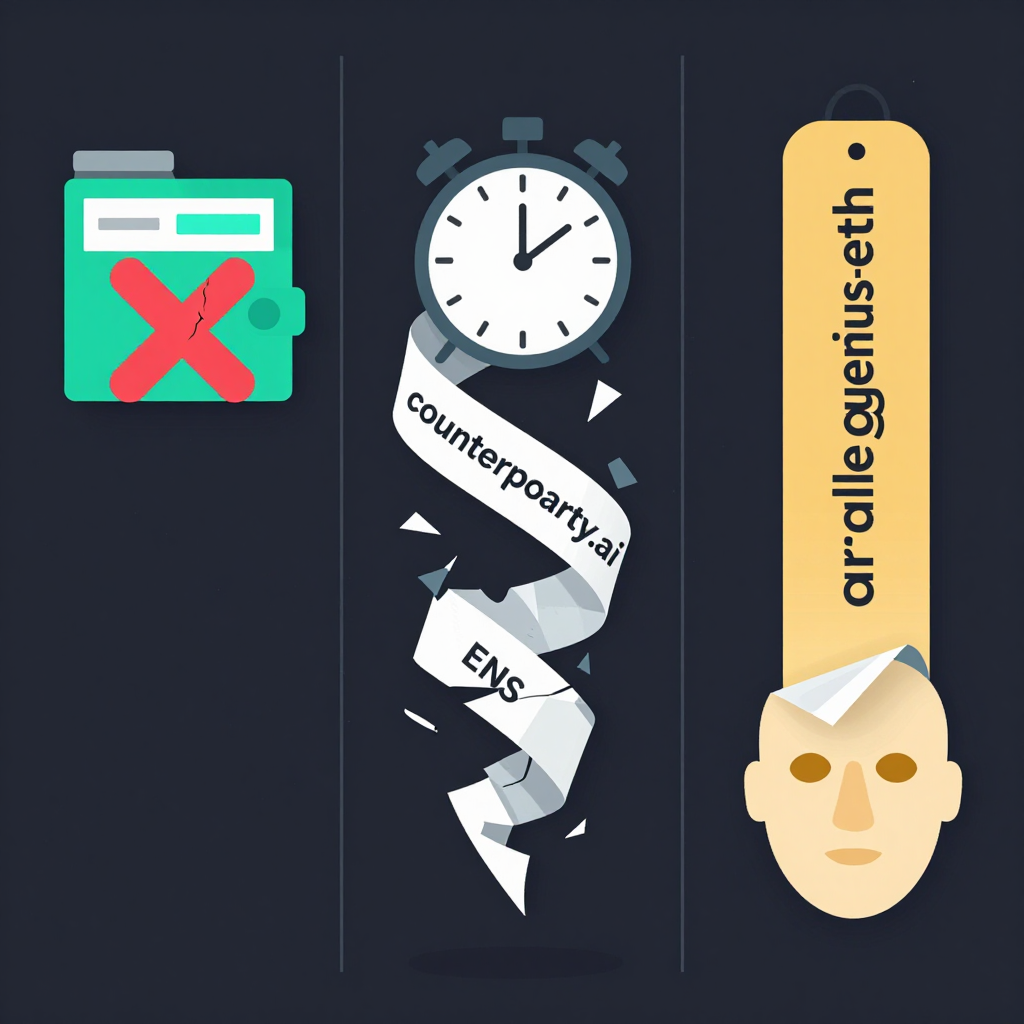
Across all three: they look like signals because they're on-chain or verifiable-looking, but none answer the only question that matters at 3 a.m. — is this counterparty what it claims, capable of what it claims, and likely to honor the deal?
That mismatch is the AI agent trust deficit — and it's exactly the gap EVIDIQ was built to close.
What Changes When EVIDIQ Is in the Loop
Same scenario. 3:17 a.m. Invoice lands. But before the agent touches a payment, it makes one call: verify_agent on the EVIDIQ MCP server. x402 kicks in, the agent pays the per-call fee in USDT0 on X Layer, and within roughly a second it gets back a structured report.
What does the report contain? Here's the flow from our own engineering notes:
-
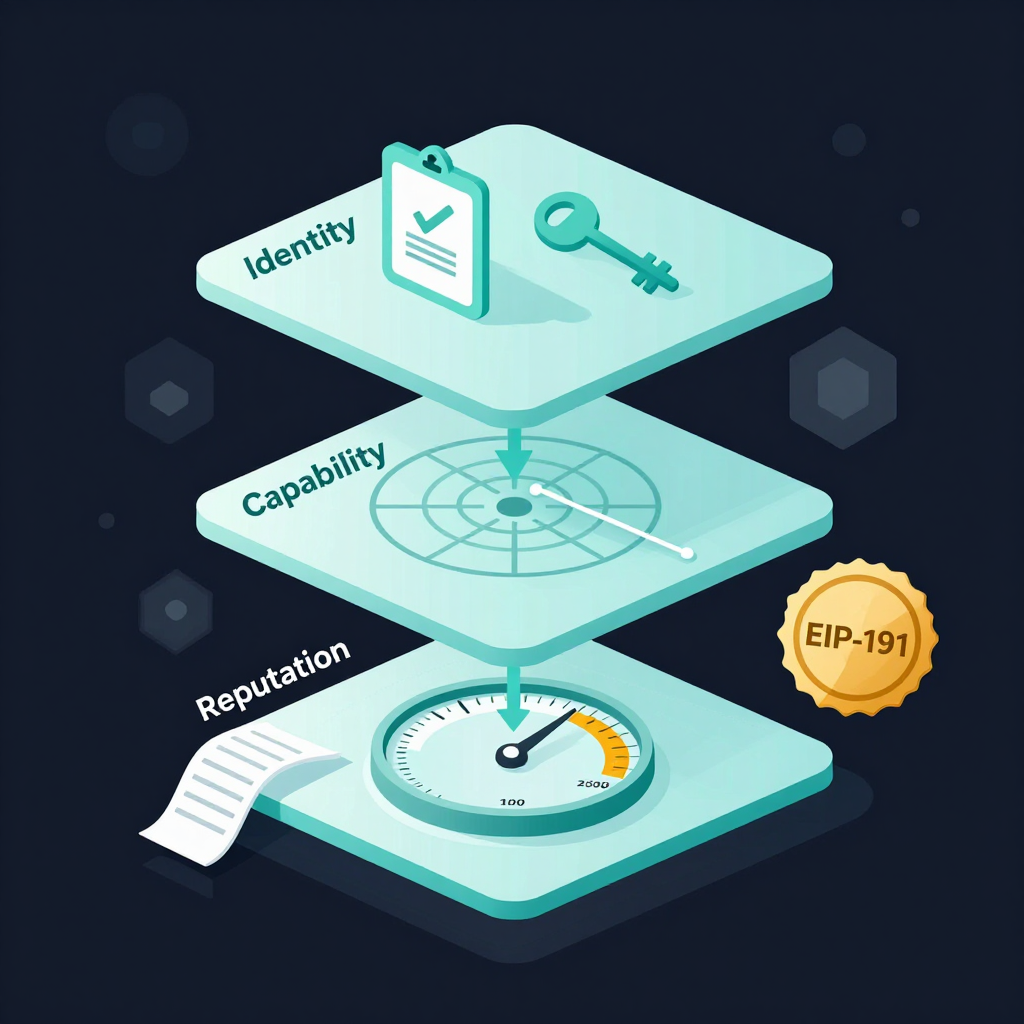
Identity resolution. EVIDIQ checks whether the counterparty controls a verifiable EVM address, holds an ERC-8004 on-chain identity id, owns an ENS name, or serves an HTTPS endpoint with a clean certificate. Each anchor adds weight to the identity sub-score.
-
Capability probe. EVIDIQ fires a bounded live GET — about six seconds, capped — against the counterparty's claimed endpoint. It checks reachability, TLS validity, and whether the response surface is a machine-readable skill, agent card, or MCP manifest. A counterparty that declares "summarization" but returns a 200 OK on a marketing landing page gets penalized.
-
Reputation signal. Today this is built from identity anchors and live signals, including whether the endpoint runs a paid x402 service — economic skin in the game. We don't pretend it's a fully-baked historical ledger yet. It's a directional indicator, weighted accordingly.
-
Risk evaluation. Optional and on-demand: an AI risk analysis can run on 0G Compute with GLM-5.2 inside a TEE, with the provider address and request id written into the evidence record. The verdict is signed with the EVIDIQ key (EIP-191).
The four sub-scores are combined deterministically: identity*0.3 + capability*0.3 + reputation*0.2 + (100-risk)*0.2. Same inputs, same score, every time. The agent doesn't get a black box — it gets the formula, the inputs, and the recommendation, all auditable on the EVIDIQ docs.
Replay the 3 a.m. invoice — wallet funded, domain old, ENS missing — and the agent now sees an identity score near zero, a capability score that craters when the endpoint returns a generic JSON, and a risk score elevated because the fresh wallet was funded via bridge hops. Trust score: 38. Recommendation: caution. Payment auto-blocked unless explicitly overridden.
Six seconds. Same counterparty. The AI agent trust deficit, closed in a single call. That's not a magic trick — that's what verification looks like when it's done structurally instead of by vibes.
This Isn't a Human Problem With an AI Costume On
Here's a trap we see builders fall into constantly: they assume agent trust can be solved with the same habits humans use. Read a review. Check a LinkedIn. Ask for a reference. Stare at the logo for two extra seconds.
Those habits don't translate to machine speed. They can't. A human has hours or days to evaluate a counterparty. An agent has the latency budget of a single inference call. Even if the agent could scrape a LinkedIn page, it has no way to know the LinkedIn isn't a sock puppet run by the same operator. The AI agent trust deficit isn't solved by borrowing human habits.
What has to replace them is structural. Three things, specifically:
- Cryptographic identity anchors that aren't optional flavor text. The EVIDIQ Sentinel docs describe how identity resolution rewards verifiable EVM addresses, ERC-8004 ids, ENS names, and TLS-served domains — each a primitive a machine can actually check.
- Live, deterministic probes of declared capabilities. The EVIDIQ Operator docs cover how we bound the probe to roughly six seconds and score against a concrete contract — declared ≠ claimed, claimed ≠ reachable, reachable ≠ correct.
- Tamper-evident evidence trails so the recommendation itself can be audited after the fact. Every report is canonical-hashed, anchored on 0G Storage mainnet, optionally analyzed on 0G Compute in a TEE, and signed with the EVIDIQ key. Anyone holding the report can re-fetch the evidence, re-hash it, and recover the signer. The verification isn't "trust EVIDIQ"; it's "verify EVIDIQ's signature yourself."
A wallet balance alone is not a trust signal. A domain age alone is not a trust signal. An ENS string alone is not a trust signal. The only honest signal is a composite one, produced by a system whose outputs you can re-derive from public inputs.
We didn't build EVIDIQ to be a reputation oracle in the abstract. We built it because we got tired of watching agents at 3 a.m. — our own, and other people's — make irreversible decisions on the strength of a domain registration date.