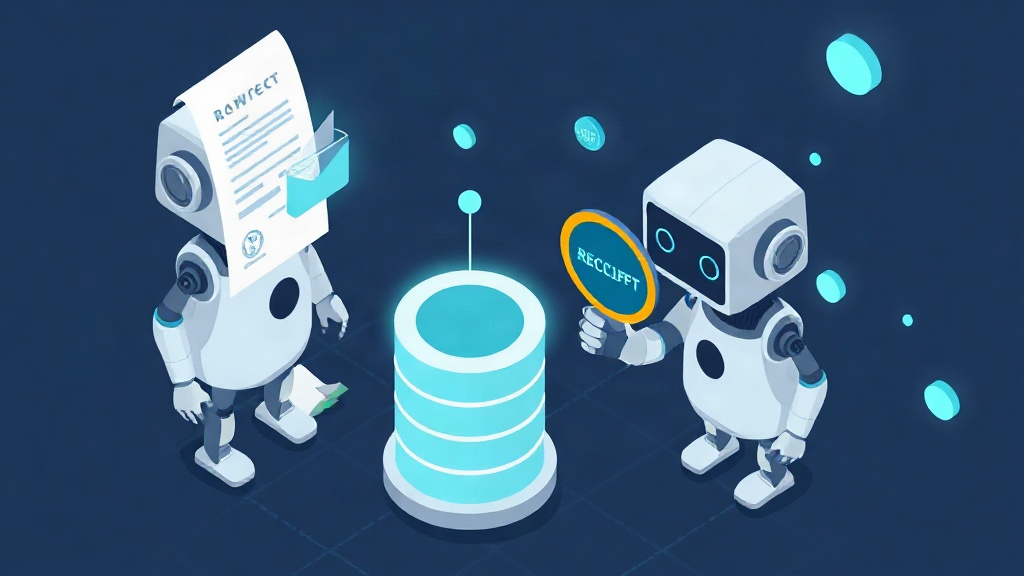
Querying Datasets From an AI Agent, Defined
To query datasets from AI agents means issuing a structured MCP tool call that returns only the answer — not the raw rows. EVIDIQ Atlas implements this as a pay-per-call x402 endpoint: the agent requests a dataset, receives structured findings and a tamper-evident artifact, and pays only for what it actually needed. No prompt stuffing, no wasted tokens.
Most agent teams we talk to still do this the expensive way: they download a CSV, paste the first 200 rows into the system prompt, and hope the model extracts a signal. Atlas is the opposite shape. You point your agent at the Atlas MCP server, and it makes a real JSON-RPC call — query_dataset, compare_datasets, list_datasets — against a hosted catalog of public datasets. The server runs the work, returns a clean artifact, and bills you per call via x402 on X Layer.
Here's the thing: the agent doesn't see the dataset. It sees the answer to its question, plus a signed receipt. That's the whole design.
The Context-Window Tax Nobody Budgets For
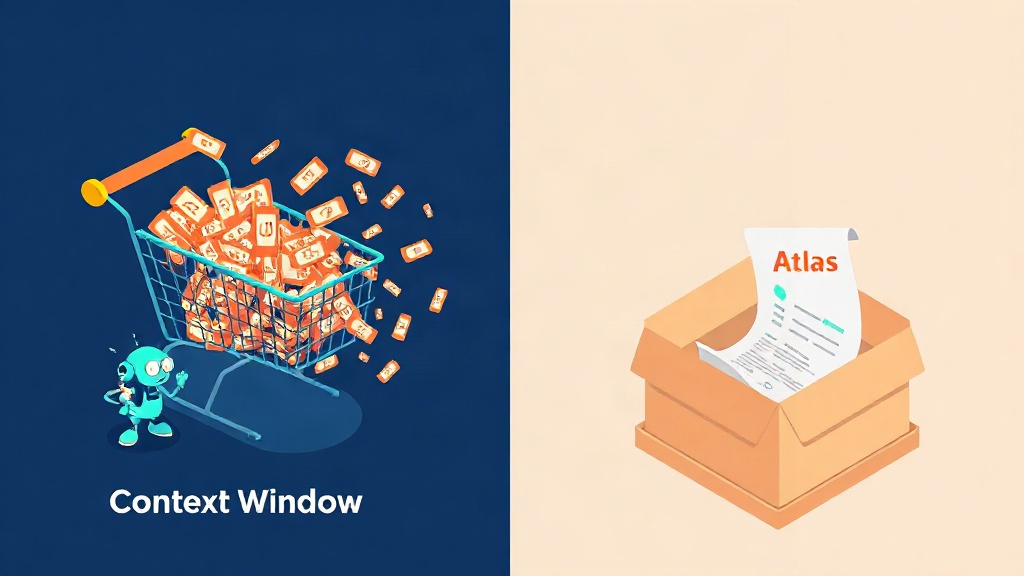
Let's do the math that nobody on the prompt-engineering Slack actually does. Suppose your agent is reasoning over a 50,000-row transaction table — call it 12MB of CSV. Stuffed raw into a modern 200K-token context window, that payload burns roughly 3.1 million input tokens before the model has even started thinking.
At current 2026 inference pricing — somewhere around $2.50 per million input tokens on the cheaper hosted tiers — you're paying $7.75 just to load the data, before the model answers your actual question. Worse, you've consumed ~1.5% of your entire context budget on raw bytes that the model will mostly ignore once it has the schema and a few summary statistics.
Now the hidden costs:
- Latency: a 3M-token prefill on a frontier model takes 8–15 seconds. Your agent can't iterate fast.
- Accuracy: long contexts dilute attention. The "lost in the middle" effect is real and well-measured — extraction accuracy on rows buried in the middle 60% of context drops 15–30%.
- Cost variance: every retry doubles the bill. Every tool call after this one pays the tax again.
- Lock-in: you've also committed your prompt to one specific snapshot of the data. Tomorrow's table is a new prompt.
Our opinionated take: context-dumping is the wrong default. It's a debugging trick that escaped into production. Atlas exists because the alternative — a small, priced tool call that returns a structured answer — is cheaper, faster, and more reproducible. When we built EVIDIQ's probe, we made the same call: probe the endpoint, don't mirror it.
The same logic applies to query datasets from AI agents as a default posture: every time your agent reaches for raw data, ask whether a priced tool call would return just the slice it needs. Nine times out of ten, yes.
One Question, One Priced Call
Walk through what actually happens when your agent invokes Atlas to query datasets from AI agents. The flow is deterministic, auditable, and ends with a hash you can verify later.
- The agent calls
estimate_cost(dataset_id, query). This is free — it returns a USDT0 amount, an estimated row count, and a list of fields the query will touch. The agent (or its planner) decides whether to proceed. - If the budget is OK, the agent calls
query_dataset(dataset_id, query, max_rows=5000). The Atlas server returns an HTTP 402 Payment Required challenge with an x402 v2 payload — schemeexact, networkx-layer, assetUSDT0, and a preciseaccepts[].amount. - The agent signs an EIP-3009
transferWithAuthorizationmessage off-chain and resends the request with theX-PAYMENTheader. No gas to the agent, no account funding step. - Atlas verifies the authorization, executes the query against the dataset, runs the comparison if requested, and returns a structured findings payload (JSON, schema-validated), a canonical artifact hashed with
keccak256, a signed receipt (EIP-191, keyed by the EVIDIQ signing address), and a 0G Storage anchor — the artifact hash written to 0G Storage mainnet, returning an on-chain tx hash anyone can re-fetch. - The agent uses the answer. The artifact is tamper-evident forever.
Here's a real sequence from our 2026 test harness — agent is comparing two snapshots of an on-chain DEX volume dataset:
// 1) free estimate
{"method":"estimate_cost","params":{"dataset_id":"dex_volume_v3","query":"sum volume by token, last 7d"}}
// -> {"estimated_cost_usdt0":"0.014","rows":120,"fields":["token","volume_usd"]}

// 2) priced call — server returns 402 with accepts[].amount = "14000"
POST /atlas  X-PAYMENT: <signed EIP-3009 authorization>

// 3) response
{
  "findings": {"top_token":"USDT","volume_usd":"4.21B","change_pct":-3.2},
  "artifact_hash": "0x9f3c...a01e",
  "storage_tx": "0xab12...f4",
  "signature": "0x7c...8d",
  "signer": "0xEVIDIQ..."
}
Three things worth pointing out. First, the agent never downloaded the dataset. Second, the cost is bounded before spending — that's the whole point of estimate_cost. Third, the receipt isn't a courtesy: it's the same evidence chain we use for the trust score in Sentinel, so if you ever need to prove when the answer was produced and by whom, it's already signed.
If you want to wire this into your own MCP client, the schema lives in the EVIDIQ docs and the source is open at the EVIDIQ repository.
Where Atlas Fits Next to Sentinel and Notary
Atlas isn't alone in the EVIDIQ MCP family. Together, they let an agent query datasets from AI agents and prove what it found. We ship three tools, each metered via x402 on X Layer, each with a sharp focus. The mental model we use internally: Sentinel checks who's at the door, Atlas inspects the room, Notary timestamps what came out of the conversation.
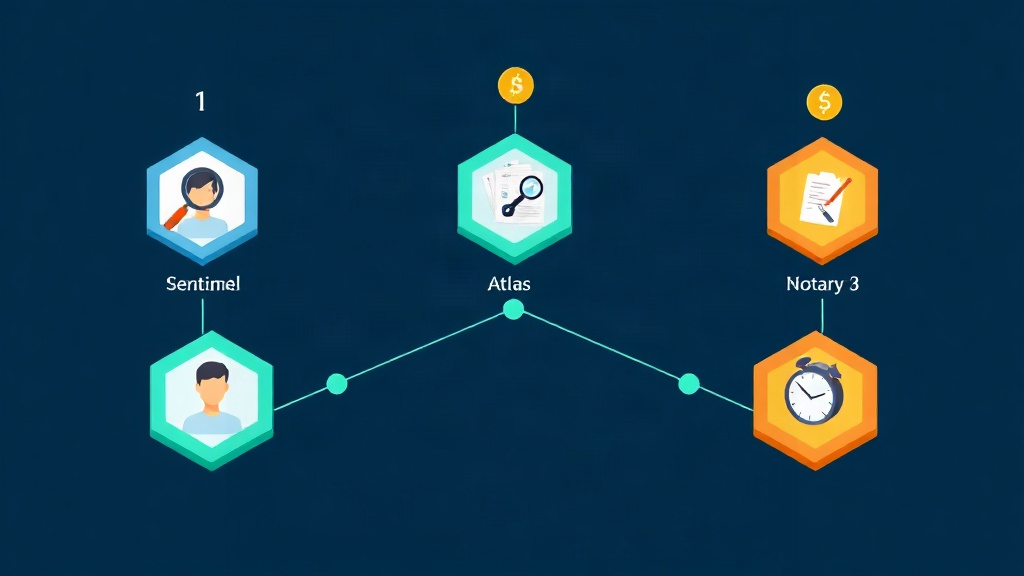
Here's the division of labor:
- EVIDIQ Sentinel docs — verifies an agent's identity, declared capabilities, and reputation signal. Returns a 0–100 trust score with a recommendation (
proceed,proceed_with_escrow,caution,do_not_proceed). Deterministic:identity*0.3 + capability*0.3 + reputation*0.2 + (100-risk)*0.2. - Atlas (this article) — analyzes data on behalf of your agent. Pay-per-call dataset queries, comparisons, and summary statistics. Same x402 payment rail, same EIP-191 receipt.
- EVIDIQ Notary docs — takes a model output (text, JSON, code, image hash) and produces a tamper-evident receipt anchored to 0G Storage, signed with the EVIDIQ key. The 0G Compute step can run a GLM-5.2 risk analysis inside a TEE and records the provider address.
And then there's EVIDIQ Operator docs — the runtime that ties these together. Operator is what orchestrates the MCP tool calls, handles the 402 challenge, and decides whether to actually spend based on the Sentinel trust score of the upstream agent. So a typical flow is: Operator sees an untrusted agent wanting data → Sentinel scores it → if the score is above threshold, Operator calls Atlas → Atlas returns findings + receipt → Notary records the chain.
Two consequences worth flagging. First, every step is independently verifiable — re-hash the artifact, recover the signer, check the 0G Storage tx. Second, none of these tools hold your funds or grant authority. We produce evidence; you decide what to do with it. That's a deliberate boundary.