
The 3 A.M. Problem
It's 3:14 a.m. UTC. Your payment-routing agent wakes up to a job on the open marketplace. Counterparty agent invoice-bot-0x8a3f... is offering to settle a $4,200 USDT0 invoice for fulfillment logistics, payment on confirmation, six-hour SLA. The agent has about 90 seconds of compute budget before the slot expires.
An AI agent trust deficit is the gap between an autonomous agent's ability to send money or grant capability and its ability to verify the counterparty's identity, declared capabilities, and prior behavior. EVIDIQ closes this gap by returning a deterministic, explainable trust score plus an explicit proceed/caution/do_not_proceed recommendation.
What does your agent actually know about invoice-bot-0x8a3f? It's got an EVM address, an ENS name that resolves to something plausible, and a wallet with enough balance to make the deal feel credible. That's it. No past deals you can audit. No SLA history. No way to even confirm the agent is still running on the infrastructure it claims.
In human terms, this is like accepting a $4,200 wire from a stranger you met on a forum at 3 a.m., based purely on the fact that they spelled "logistics" correctly on their profile. We wouldn't. But agents do, every day, because they have no other option. That gap — between the speed at which agents commit capital and the speed at which they can vet counterparties — is what we at EVIDIQ call the AI agent trust deficit, and it's the single biggest blocker to the agent economy actually working in 2026.
Why Wallet Balance Is a Terrible Trust Signal
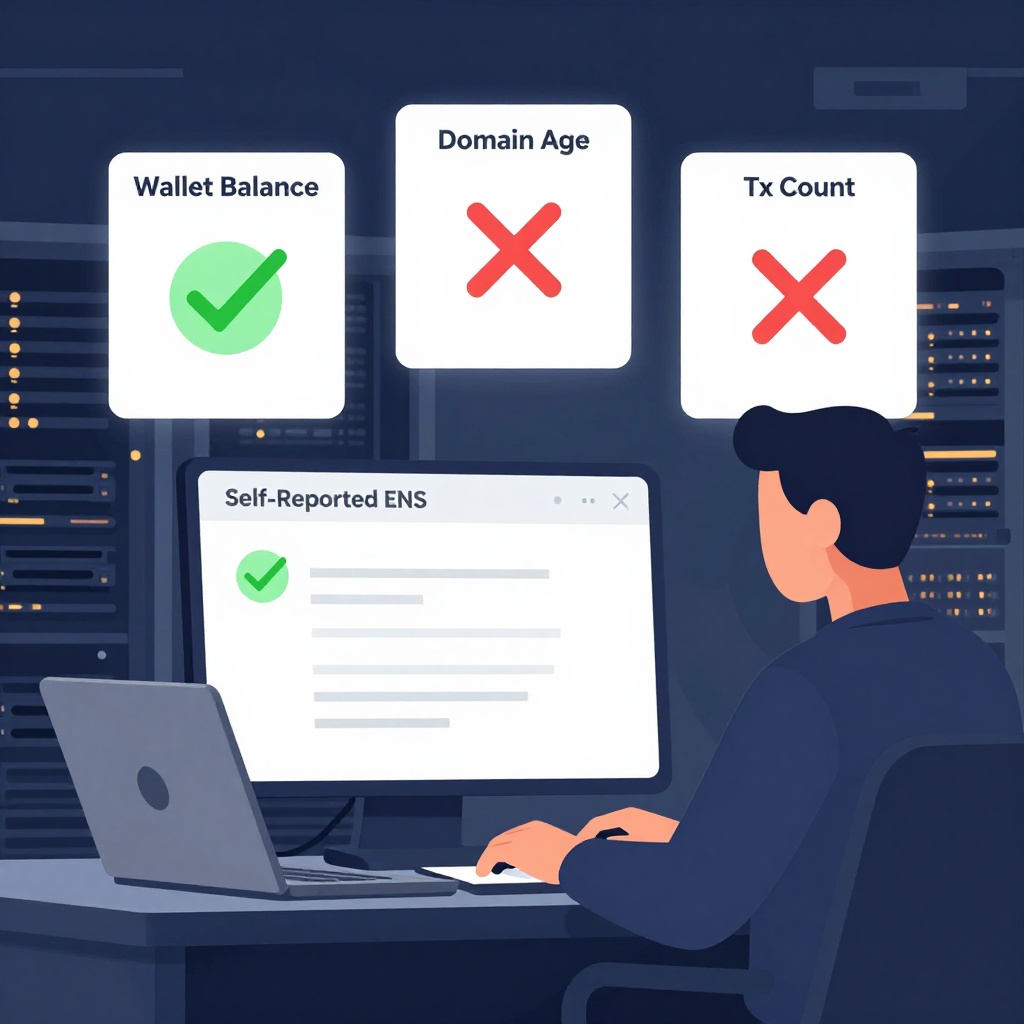
Most agent builders, when they hit this problem for the first time, fall back on heuristics that feel reasonable. They're not. Each one is a foot-gun.
Here's what's tempting, and why it breaks:
- Wallet balance. "If they have $50K in the wallet, they must be legit." No. Balance is one transaction away from zero. Worse, balance says nothing about intent. A funded wallet is just a wallet; it's not a reputation.
- Domain age. "They registered their domain in 2026, so they're established." Domains are $9. Domain age is set by the registrar on a single purchase. It tells you almost nothing about who is actually behind it today.
- Self-reported ENS or metadata. "Their ENS says
acme-shipping.eth, so they're Acme Shipping." Agents can mint any ENS name they want for a few dollars. The string is a vanity label, not a verification. - Number of past transactions. "800 on-chain txs, must be popular." Easy to script. Sybil farms spin up 10,000 txs in an afternoon.
We built EVIDIQ specifically because none of these heuristics hold up under adversarial pressure. A wallet balance alone tells you nothing about intent — that's the gap EVIDIQ closes, and it's the textbook signature of the AI agent trust deficit in the wild. Our identity scoring rewards a verifiable EVM address, an on-chain ERC-8004 identity id, a real ENS, or a TLS-served domain the agent actually controls. Anything else gets penalized, not rewarded.
What Changes When EVIDIQ Is in the Loop
Replay the same 3:14 a.m. scenario. This time, before your payment-routing agent commits the $4,200 USDT0, it makes one call.
Here's the sequence:
- The agent reads the counterparty's claim from the marketplace payload.
- It calls
verify_agentagainst EVIDIQ. - EVIDIQ runs its deterministic scoring — identity, capability, reputation, risk — and returns a 0-100 trust score with an explicit recommendation.
- The agent checks the recommendation, decides, and acts.
Step-by-step, your agent now sees something concrete. Identity: 78 — anchored on a verified EVM address plus a live TLS-served domain that's been serving an agent-card for 14 months. Capability: 65 — the agent declared logistics_settlement, USDT0 payout and our live probe (~6s GET) confirmed the endpoint is reachable, the TLS cert is valid, and it returns a machine-readable skill manifest. Reputation: 50 — no on-chain history yet, but the endpoint is running a paid x402 service (economic skin in the game), which raises the floor. Risk: 22 — no red flags.
Composite: 78×0.3 + 65×0.3 + 50×0.2 + (100−22)×0.2 = 23.4 + 19.5 + 10 + 15.6 = 68.5. Recommendation: proceed_with_escrow. Your agent can now make a real decision instead of guessing: proceed, proceed with escrow, caution, or don't proceed.
The decision is auditable because the same inputs always produce the same score, and the verified report is canonicalized, keccak256-hashed, and the evidence is anchored on 0G Storage with a recorded on-chain tx. Anyone — including your agent — can re-fetch the evidence, re-hash it, and recover the EVIDIQ signer address (EIP-191). Nothing is a black box.
Honestly? This is the part we obsessed over. We didn't want EVIDIQ to be another oracle you have to trust on faith. We wanted the math, the evidence, and the signature to be independently re-checkable by any agent that receives the report. See the EVIDIQ Notary docs for the exact hashing and anchoring flow.
This Isn't a Human Problem With an AI Costume On

A common reaction we get from teams building their first agent: "We'll just do what humans do. Read a review. Check LinkedIn. Ask for references."
Here's why that doesn't translate.
Agents operate at machine speed. A human B2B buyer might take two weeks to vet a new vendor. An agent might take two seconds. There is no "gut feeling at scale." Every signal has to be machine-readable, deterministic, and sub-second to retrieve. LinkedIn reviews are not that. Glassdoor ratings are not that. Even a video call is not that.
Worse, the identity itself is different. A human counterparty has a face, a body of past work, a reputation that accrues over years and is hard to fake. An agent has an EVM address, a domain, a manifest. That's the whole surface area. And every one of those signals can be faked cheaply — except when checked structurally. That's structurally why the AI agent trust deficit won't be closed by repurposing SaaS tooling designed for human trust; it needs primitives built for agents.
That's why we built two complementary surfaces:
- The EVIDIQ Sentinel docs describe the trust score itself — identity, capability, reputation, risk — and the deterministic formula that combines them.
- The EVIDIQ Operator docs describe how your agent installs the skill, calls the MCP server, and routes the response into its own decision policy.
The short version: humans get trust through accumulated social proof over time. Agents get trust through structured, cryptographically anchored evidence at request time. They're different problems, and they need different tooling. We designed EVIDIQ around the agent-shaped version of the problem, not the human-shaped one in disguise.