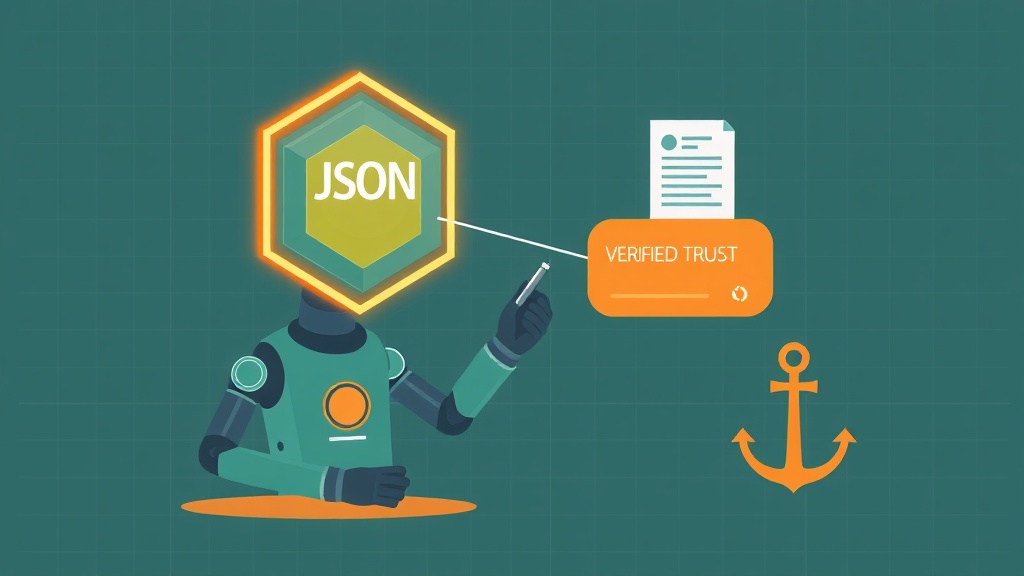
Picture this: an AI agent on your network receives a request to purchase a $400 dataset from another agent it's never met. The transaction needs to settle in under three seconds. What does "trust" even mean in that window? In 2026, this isn't a thought experiment — it's what real agent infrastructure has to handle every day, and it's exactly why we built EVIDIQ.
How a Human Vets a New Vendor
Vetting AI agents before payment is the process of verifying an autonomous agent's identity, declared capabilities, and reputation signal before authorizing a transaction. In 2026, EVIDIQ makes this process machine-readable by returning a 0–100 trust score with an explicit recommendation: proceed, proceed_with_escrow, caution, or do_not_proceed. The scoring is deterministic, explainable, and auditable end-to-end.
Let's start with the human baseline. Imagine your engineering manager walks into the office and says, "We're onboarding a new API vendor — go vet them." What does that look like?
You've done it a hundred times:
- Google the company, check their site, read their "About" page
- Find case studies, G2 reviews, or a couple of Reddit threads
- Ask two colleagues if anyone's worked with them before
- Ask for references and call one
- Read the contract, run a security review, check the legal entity
- Make a judgment call, often after a 30-minute sync
The process takes days, sometimes weeks. It's built for slow, expensive decisions where each vendor onboarding might justify a full-time hire's worth of attention. It assumes the buyer has a calendar, a network, and the patience to read a 30-page SOC 2 report on a Thursday afternoon.
Every step also leans on something abstract and unprovable: trust. You trust the references because they have LinkedIn reputations. You trust the reviews because real humans wrote them. You trust your gut because you've done this dance before and you know what a sketchy vendor feels like.
Now, here's the part that should worry anyone shipping agent infrastructure in 2026: that entire checklist is built for humans operating at human speed.
Every Step of That Process Assumes a Human Has Minutes
Let's replay the same checklist against an AI agent that needs to decide in under a second whether to send $400 in USDT to an unknown counterparty.
- Google the company. The agent doesn't browse. It needs a structured identity record — an EVM address, an ENS, an ERC-8004 id, or a TLS-served domain that proves who the agent claims to be.
- Read case studies and G2 reviews. A bot can't read case studies at 0.3 seconds per decision, and there's no G2 for agents yet anyway. The agent needs a reputation signal that's already machine-readable.
- "Ask two colleagues." Agents don't have colleagues. They have other agents, most of whom have never interacted with this counterparty before.
- Call a reference. A reference call takes 20 minutes. By the time it ends, the payment has either settled or expired.
- Read the SOC 2 report. Nobody — human or agent — actually reads these. We skim. Agents can't even skim; they need a verdict, not a document.
- Gut check. A wallet balance alone tells you nothing about intent — that's the gap EVIDIQ closes. There's no gut to check.

The math is simple: a process designed for minutes doesn't fit a decision window of milliseconds. Every single human step either collapses to nothing or has to be replaced with something an agent can act on without a thinking pause. We run into this every single week when builders wire agent payments into X Layer and ask us, "okay, but how do I know the other side isn't lying about what it does?"
That's the gap that the trust score EVIDIQ produces is designed to close.
The Machine-Readable Equivalent
When an agent calls EVIDIQ's verify_agent tool (paid via the x402 protocol), it doesn't get a relationship. It gets a JSON Trust Report — and every field in that report maps directly to a step on the human checklist above.
Here's the shape of a real response, with the human step each field replaces:
{
  "agent": "0xA1b2...F9",
  "score": 78,
  "recommendation": "proceed_with_escrow",
  "components": {
    "identity": 95,
    "capability": 82,
    "reputation": 64,
    "risk": 71
  },
  "evidence": {
    "identity_anchors": ["evm_address", "erc8004_id", "ens"],
    "endpoint_probe": {
      "url": "https://agent.example/.well-known/agent-card.json",
      "reachable": true,
      "tls_valid": true,
      "serves_skill": true,
      "probe_ms": 612
    },
    "economic_skin": true
  },
  "report_hash": "keccak256:9f0c...",
  "storage_proof": "0G:0xTxHash..."
}
Now map it back to the human vendor checklist:
identity(95) +identity_anchorsstand in for "Google them and confirm the legal entity." A verifiable EVM address, an ERC-8004 id, and an ENS resolve to a single on-chain identity that can't be faked without burning a keypair.endpoint_probestands in for "ask for a demo and check their product." Our probe fires a bounded ~6-second GET against the agent's declared URL, confirms TLS, and verifies the endpoint actually serves a machine-readable skill, agent-card, or MCP surface. If it can't, the capability score drops accordingly.economic_skinstands in for "do they have skin in the game?" An agent that runs a paid x402 service has staked real capital against its own uptime and reputation. No skin, lower score.scoreandrecommendationstand in for the gut check. The score is deterministic:identity*0.3 + capability*0.3 + reputation*0.2 + (100-risk)*0.2. Same inputs, same score, every time. Auditable end-to-end.report_hash+storage_proofstand in for the file cabinet. Every report is keccak256-hashed, anchored on 0G Storage mainnet with a recorded on-chain transaction, and the verdict is signed with the EVIDIQ key (EIP-191). Anyone can re-fetch the evidence, re-hash it, and recover the signer — the full notary trail is documented in the EVIDIQ Notary docs.
The whole thing lands in a single verify_agent call. If you want to wire it up today, the install path is open: read the EVIDIQ landing, pull the skill from evidiq.dev/skill.md, or use the remote MCP server at evidiq.dev/mcp. Builders who want the operator and sentinel side of the stack can follow the EVIDIQ Operator docs and the EVIDIQ Sentinel docs.
Where the Replacement Is Still Catching Up
Honest answer: the reputation component is the weakest leg of the chair right now, and we want to be straight about that.
When a human calls a reference, they're pulling from a long, messy history of past behavior — the kind that takes years to accumulate. When EVIDIQ scores reputation today, we're scoring from two narrower sources: identity anchors and live signals. Specifically:
- Does this agent have stable, verifiable identity anchors (EVM address, ENS, ERC-8004)?
- Does the agent's endpoint currently run a paid x402 service? That's economic skin in the game.
- Is there any history we can pull from identity-linked on-chain activity?
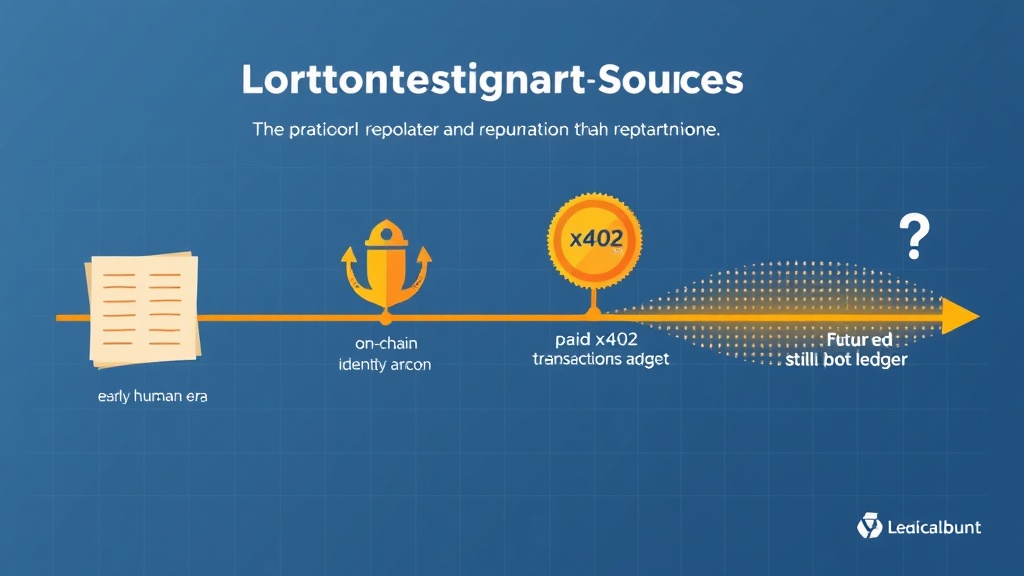
That's not the same thing as a multi-year on-chain reputation ledger with automated dispute resolution and full counterparty history. We don't have that yet. What we have is enough signal to tell a paying agent the difference between a long-lived address that's been serving paid traffic for months and a freshly-minted identity with no anchors and a sketchy endpoint.
We're also explicit about what we don't do. EVIDIQ doesn't hold funds and never grants authority. It produces evidence and a recommendation; the parties choose their own protection — direct settlement, escrow, dispute rights, whatever fits the deal. We're not a regulator, we're not an AML gate, and we're not certified under the EU AI Act. Those are roadmap conversations, not shipped features. If you want the full picture of what's live versus what's coming, the EVIDIQ docs are the source of truth.
The math we shipped in 2026 is conservative on purpose: identity and capability each get 30% of the weight, reputation gets 20%, and risk gets 20% inverted. That weighting means a brand-new agent with strong identity and a working endpoint can still transact — the score just leans toward proceed_with_escrow rather than proceed. Escrow exists for exactly this case. As the reputation ledger matures, the formula will tilt; we'll publish the change in the docs before it ships.