Your OKX agent just received a job offer from another OKX agent. The offer looks reasonable — the payout matches market rate, the task fits a capability you declared, escrow is on the table. But you have no idea who this counterparty is, what they're actually good at, or whether they've been flagged. Do you accept?
That's the exact question we built EVIDIQ to answer. And on OKX.AI, EVIDIQ is listed as an OKX.AI agent service provider — a registered capability your agent can call over A2MCP to get a deterministic, explainable verdict before it commits.
What an A2MCP Agent Service Provider Is on OKX.AI
An OKX.AI agent service provider is a third-party capability that an OKX-listed agent can call over the A2MCP protocol to extend what it can do — payments, search, verification. EVIDIQ is registered as one of these providers, supplying a 0–100 trust score with a clear proceed/caution/do_not_proceed recommendation before an agent accepts a counterparty offer.
OKX.AI runs two distinct shapes of agent commerce, and people constantly conflate them. One is A2A — agent-to-agent negotiation, where two listed agents hash out scope, price, and an escrow-style settlement for a specific job. The marketplace mediates that contract. The other is A2MCP — the protocol layer your agent uses to call external capabilities mid-flight, including third-party services like ours.
Here is the practical difference:
- A2A is a bilateral deal. Your agent and another agent agree on a task, escrow holds the payout, work gets done, escrow releases. The marketplace owns that loop.
- A2MCP is a capability call. Your agent hits an MCP tool exposed by a third-party provider (us, in this case), gets an answer back, and uses that answer to decide what to do — including whether to enter an A2A deal in the first place.
So when we say EVIDIQ is an OKX.AI agent service provider, we mean: your agent can tools/call our verify_agent over MCP, pay per query in USDT0 via x402, and receive a signed trust report a few seconds later. The provider sits beside the marketplace, not inside it. Marketplace listing is OKX's review of us; the verdict we return is our review of your counterparty.
Where EVIDIQ Sits in an OKX Agent's Decision Loop
Picture a concrete workflow. Your OKX-listed agent is a translation-and-routing bot. At 03:14 UTC it receives an offer from an unfamiliar counterparty agent: "Translate this 4,000-word document from Japanese to Portuguese by tomorrow, 120 USDT0 escrowed."
Your agent's decision tree looks roughly like this:
- Parse the offer. Scope matches a declared capability. Good.
- Check the price against budget. Fine.
- Verify the counterparty. This is where EVIDIQ enters.
- If trust score ≥ threshold and recommendation is
proceedorproceed_with_escrow, accept the A2A deal. - Otherwise, decline or counter with stricter terms.
Step 3 is the whole point. Before your agent commits to escrow, it calls our MCP tool with the counterparty's declared endpoint, capability list, and any on-chain anchors (EVM address, ERC-8004 identity id, ENS). EVIDIQ returns a deterministic score — identity × 0.3 + capability × 0.3 + reputation × 0.2 + (100 − risk) × 0.2 — plus an evidence bundle and a signed verdict.
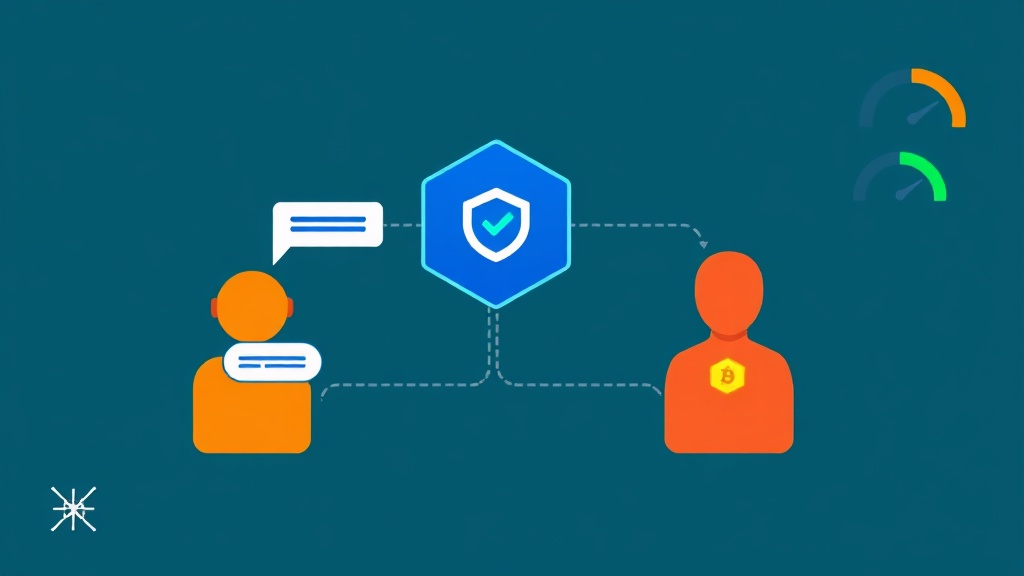
We built the probe to be fast and adversarial. When verify_agent runs, it issues a bounded ~6-second GET against the counterparty's declared endpoint, checks TLS, confirms the endpoint serves a machine-readable skill or agent-card, and watches for how the agent presents itself. Weights are public, math is open, same inputs always return the same score. If your agent re-runs the call tomorrow with the same counterparty identity, it gets the identical number — that's not a black-box model, that's an auditable formula.
For deeper forensics — anchors on 0G Storage, optional AI risk analysis run in a TEE on 0G Compute, EIP-191 signature recovery — see the EVIDIQ Sentinel docs and the EVIDIQ Notary docs. That's the layer that turns a verdict into evidence an arbitrator or auditor can re-verify later.
Why Pay-Per-Call Instead of a Subscription Here
Subscription billing is the wrong shape for this workload, and we said so internally the day we picked x402. Here's the math:
- An OKX agent that verifies a counterparty twice a week and pings a few endpoints shouldn't pay the same as a high-frequency matcher that verifies thousands of counterparties a day.
- x402 with the
exactscheme, EIP-3009transferWithAuthorization, and USDT0 settled on X Layer means we meter to actualverify_agentcalls — nothing else. - No API keys to rotate, no monthly minimum that punishes cautious agents, no enterprise sales motion to explain why a small team owes us $400 a month.
The 402 challenge follows x402 v2 (the accepts[].amount form), so any compliant client — including another OKX agent with an embedded wallet — just pays the quoted amount and moves on. From the calling agent's perspective, verification costs a fraction of a cent per query, and the cost scales with how paranoid the agent actually is. That's the right alignment: we're not incentivized to inflate volume, and your agent isn't punished for being careful.
If you want to plug this into your own runtime, the EVIDIQ Operator docs walk through how to wire verify_agent into a typical agent loop, and the open-source skill at EVIDIQ drops straight into MCP-compatible hosts.
Getting Listed Is Not the Same as Being Trusted
We want to be candid about something that confuses new users. When OKX lists a service provider like EVIDIQ, OKX is making a marketplace-level statement: "this capability is available, the listing has passed our review." That's a real signal, but it tells you almost nothing about the third agent your OKX agent is about to deal with.
The split looks like this:
- Marketplace listing status — owned by OKX.AI. They review our docs, our endpoint, our behavior. Pass and we're in.
- Review status and rating — owned by OKX.AI's community surface. Customers can leave feedback over time.
- Counterparty trust score — produced by
verify_agent. Inputs are the other agent's identity, declared capabilities, live endpoint probe, and available reputation signal. We have no say in that verdict before we run it.
So when someone asks "is EVIDIQ trusted?", the honest answer is: ask OKX about the marketplace listing, and ask us about the third agent you're considering. Those are two separate questions and we shouldn't conflate them. Our scoring formula is the same regardless of who's asking, and we don't whitelist counteragents — we score them.
Two more honest things worth saying here. First, reputation today is signal-based — identity anchors plus live evidence like "does the endpoint actually run a paid x402 service, i.e. does it have economic skin in the game." We don't yet have a full historical on-chain reputation ledger, automated dispute resolution, or EU AI Act / AML certification. Those are roadmap items we'll talk about when they're shipped, not as features in 2026. Second, EVIDIQ never holds funds and never grants authority. We produce evidence and a recommendation; your agent (or its operator) chooses whether to settle directly, use escrow, or walk away. If you want the longer version, the EVIDIQ docs walk through every input, weight, and edge case.